
| Date | 28th, Oct 2022 |
|---|
Home > Press > Improving the efficiency of nanogenerators that harvest static electricity
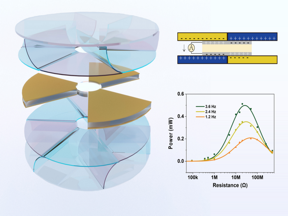 This diagram shows the schematic of the constant inherent capacitance triboelectric nanogenerator, the working mechanism of the device with two surfaces rubbing against each other, and the output powers of the device.
CREDIT
Nano Research
This diagram shows the schematic of the constant inherent capacitance triboelectric nanogenerator, the working mechanism of the device with two surfaces rubbing against each other, and the output powers of the device.
CREDIT
Nano Research
Abstract: Triboelectric energy is the scientific term for static electricity, or the energy that is created when two surfaces rub against each other. Electrons are exchanged between the two surfaces, charging one of the surfaces after they are separated. For example, if a balloon is rubbed against hair, it will cling to a wall. Or if clothes in the dryer rub together, you may see sparks as you pull them apart. Triboelectric generators are mechanical energy harvesters that can generate electricity from two surfaces rubbing against each other. These tiny power generators can be used to power wearable electronic devices, sensors, and other advanced technologies.
Tsinghua, China | Posted on October 28th, 2022
In a new paper, researchers theorize a new way to design triboelectric nanogenerators with a constant inherent capacitance. Currently, these nanogenerators use a time-dependent inherent capacitance, but research suggests that this change could increase their energy conversion efficiency.
The paper was published on October 26 in Nano Research.
�Triboelectric nanogenerators can provide a feasible way to convert mechanical energy into electricity,� said Youfan Hu, a professor at the School of Electronics at Peking University in China. �With improved efficiency and sensitivity, even very weak mechanical energy �hidden� in the environment can be caught and utilized.�
Capacitance is the ability of the nanogenerator�s capacitor to store electric charges. To prove that the constant inherent capacitance could work, researchers first developed a mathematical model to analyze the potential of the triboelectric nanogenerators with constant inherent capacitance. Then the researchers fabricated a version of the nanogenerator in order to test its efficiency and compare it to existing time-dependent inherent capacitance.
The capacitors were charged using three different styles of power conditioning circuits to test the performance of the two different triboelectric nanogenerators. They found that both triboelectric nanogenerators worked better on a full wave power circuit, but that the constant inherent capacitance triboelectric nanogenerators were able to store approximately two times the charge as the time-dependent inherent capacitance triboelectric nanogenerators. This gives the constant inherent capacitance triboelectric nanogenerators a big advantage. They also found that this form of nanogenerator could charge very quickly.
�The results of our study show that triboelectric nanogenerators with a constant capacitance design are more efficient for harvesting mechanical energy from the environment and delivering the load,� said Hu.
Finally, to prove how this type of triboelectric nanogenerator could be used in a real-world application, researchers create an anemometer based on their technology. An anemometer measures wind speed and direction. When the kinetic energy of the wind moved the cups on the anemometer, the triboelectric nanogenerator was able to turn that information into electric signal , which could be processed as the measurements of the wind speed. The anemometer was able to process the information in real-time and send it to the researchers.
This style of triboelectric nanogenerator is also easy to manufacture and easy to design, so looking ahead, researchers will be studying how to make the device even more practical so it can be applied to a wide range of devices. They will also study how to improve its efficiency even more. �The next step is to miniaturize the device and optimize the power management circuits. Ultimately, triboelectric nanogenerators will be able to serve in an integrated electronic system with a small footprint,� said Hu.
Other contributors include Lanyue Gan, Xijun Jiang, and Yuxuan Liu of the Hunan Institute of Advanced Sensing and Information Technology at Xiangtan University; Fan Xia of the Key Laboratory for the Physics and Chemistry of Nanodevices at Peking University; Panpan Zhang at the School of Mechanical Engineering at Shanghai Jiao Tong University; and Simiao Niu at the Department of Biomedical Engineering at Rutgers University.
The National Natural Science Foundation of China and the High-performance Computing Platform of Peking University supported this research.
####
About Tsinghua University PressEstablished in 1980, belonging to Tsinghua University, Tsinghua University Press (TUP) is a leading comprehensive higher education and professional publisher in China. Committed to building a top-level global cultural brand, after 41 years of development, TUP has established an outstanding managerial system and enterprise structure, and delivered multimedia and multi-dimensional publications covering books, audio, video, electronic products, journals and digital publications. In addition, TUP actively carries out its strategic transformation from educational publishing to content development and service for teaching & learning and was named First-class National Publisher for achieving remarkable results.
About Nano Research
Nano Research is a peer-reviewed, international and interdisciplinary research journal, publishes all aspects of nano science and technology, featured in rapid review and fast publishing, sponsored by Tsinghua University and the Chinese Chemical Society. It offers readers an attractive mix of authoritative and comprehensive reviews and original cutting-edge research papers. After 15 years of development, it has become one of the most influential academic journals in the nano field. In 2022 InCites Journal Citation Reports, Nano Research has an Impact Factor of 10.269 (9.136, 5 years), the total cites reached 29620, ranking first in China's international academic journals, and the number of highly cited papers reached 120, ranked among the top 2.8% of over 9000 academic journals.
For more information, please click here
Contacts:Yao MengTsinghua University Press
Office: 86-108-347-0574
Copyright © Tsinghua University Press
If you have a comment, please Contact us.
Issuers of news releases, not 7th Wave, Inc. or Nanotechnology Now, are solely responsible for the accuracy of the content.
Bookmark:


News and information
 HKUST researchers develop a novel integration scheme for efficient coupling between III-V and silicon November 18th, 2022
Researchers at Purdue unlock light-matter interactions on sub-nanometer scales, leading to �picophotonics� November 18th, 2022
Rice turns asphaltene into graphene for composites: �Flashed� byproduct of crude oil could bolster materials, polymer inks November 18th, 2022
How �2D� materials expand: New technique that accurately measures how atom-thin materials expand when heated could help engineers develop faster, more powerful electronic devices November 18th, 2022
Possible Futures
HKUST researchers develop a novel integration scheme for efficient coupling between III-V and silicon November 18th, 2022
NIST�s grid of quantum islands could reveal secrets for powerful technologies November 18th, 2022
Discoveries
An on-chip time-lens generates ultrafast pulses: New device opens the doors to applications in communication, quantum computing, astronomy November 18th, 2022
Researchers at Purdue unlock light-matter interactions on sub-nanometer scales, leading to �picophotonics� November 18th, 2022
Rice turns asphaltene into graphene for composites: �Flashed� byproduct of crude oil could bolster materials, polymer inks November 18th, 2022
How �2D� materials expand: New technique that accurately measures how atom-thin materials expand when heated could help engineers develop faster, more powerful electronic devices November 18th, 2022
Announcements
HKUST researchers develop a novel integration scheme for efficient coupling between III-V and silicon November 18th, 2022
NIST�s grid of quantum islands could reveal secrets for powerful technologies November 18th, 2022
How �2D� materials expand: New technique that accurately measures how atom-thin materials expand when heated could help engineers develop faster, more powerful electronic devices November 18th, 2022
Interviews/Book Reviews/Essays/Reports/Podcasts/Journals/White papers/Posters
An on-chip time-lens generates ultrafast pulses: New device opens the doors to applications in communication, quantum computing, astronomy November 18th, 2022
Researchers at Purdue unlock light-matter interactions on sub-nanometer scales, leading to �picophotonics� November 18th, 2022
Rice turns asphaltene into graphene for composites: �Flashed� byproduct of crude oil could bolster materials, polymer inks November 18th, 2022
How �2D� materials expand: New technique that accurately measures how atom-thin materials expand when heated could help engineers develop faster, more powerful electronic devices November 18th, 2022
Energy
Predicting the device performance of the perovskite solar cells from the experimental parameters through machine learning of existing experimental results November 18th, 2022
Rice turns asphaltene into graphene for composites: �Flashed� byproduct of crude oil could bolster materials, polymer inks November 18th, 2022
New insights into energy loss open doors for one up-and-coming solar tech November 18th, 2022
Advances in thermoelectric power generation possible with various �metal chalcogenide� materials, recent review shows November 4th, 2022
Battery Technology/Capacitors/Generators/Piezoelectrics/Thermoelectrics/Energy storage
Semi-nonlinear etchless lithium niobate waveguide with bound states in the continuum November 4th, 2022
Advances in thermoelectric power generation possible with various �metal chalcogenide� materials, recent review shows November 4th, 2022
The battery that runs 630 km on a single charge October 7th, 2022
