
| Date | 5th, Nov 2022 |
|---|
Home > Press > Plant fibers for sustainable devices: Research into thermal properties of cellulose nanofibers yields surprising results
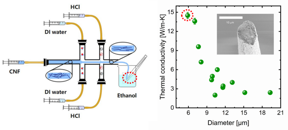 The apparatus to create thermally conducting CNF using disorganized CNF, water and hydrochloric acid (left). A graph showing how thermal conductivity of the sample changes with its diameter. (right).
CREDIT
�2022 Shiomi et al.
The apparatus to create thermally conducting CNF using disorganized CNF, water and hydrochloric acid (left). A graph showing how thermal conductivity of the sample changes with its diameter. (right).
CREDIT
�2022 Shiomi et al.
Abstract: Plant-derived materials such as cellulose often exhibit thermally insulating properties. A new material made from nanoscale cellulose fibers shows the reverse, high thermal conductivity. This makes it useful in areas previously dominated by synthetic polymer materials. Materials based on cellulose have environmental benefits over polymers, so research on this could lead to greener technological applications where thermal conductivity is needed.
Tokyo, Japan | Posted on November 4th, 2022
Cellulose is a key structural component of plant cell walls and is the reason why trees can grow to such heights. But the secret of its material strength actually lies in its overlapping nanoscopic fibers. In recent years, many commercial products have used cellulose nanofiber (CNF) materials because their strength and durability make them a good replacement for polymer-based materials such as plastics that can be detrimental to the environment. But now and for the first time, a research team led by Professor Junichiro Shiomi from the University of Tokyo�s Graduate School of Engineering has investigated previously unknown thermal properties of CNF, and their findings show these materials could be even more useful still.
�If you see plant-derived materials such as cellulose or woody biomass used in applications, it�s typically mechanical or thermally insulating properties that are being employed,� said Shiomi. �When we explored the thermal properties of a yarn made from CNF, however, we found that they show a different kind of thermal behavior, thermal conduction, and it�s very significant, around 100 times higher than that of typical woody biomass or cellulose paper.�
The reason yarn made from CNF can conduct heat so well is due to the way it�s made. Cellulose fibers in nature are very disorganized, but a process called the flow-focusing method combines cellulose fibers, orientating them in the same way, to create CNF. It�s this tightly bound and aligned bundle of rod-shaped fibers that allows heat to transfer along the bundle, whereas in a more chaotic structure it would dissipate heat more readily.
�Our main challenge was how to measure the thermal conductivity of such small physical samples and with great accuracy,� said Shiomi. �For this, we turned to a technique called T-type thermal conductivity measurement. It allowed us to measure the thermal conductivity of the rod-shaped CNF yarn samples which are only micrometers (a micrometer equaling one-thousandth of a millimeter) in diameter. But the next step for us is to perform accurate thermal tests on two-dimensional textilelike samples.�
Shiomi and his team hope that their investigation and future explorations into the use of CNF as a thermally conductive material could give engineers an alternative to some environmentally damaging polymers. In applications where heat transfer is important, such as certain electronic or computational components, it could greatly reduce the consequences of discarded electronic equipment, or e-waste, thanks to the biodegradable nature of CNF and other plant-based materials.
####
About University of TokyoThe University of Tokyo is Japan's leading university and one of the world's top research universities. The vast research output of some 6,000 researchers is published in the world's top journals across the arts and sciences. Our vibrant student body of around 15,000 undergraduate and 15,000 graduate students includes over 4,000 international students. Find out more at www.u-tokyo.ac.jp/en/ or follow us on Twitter at @UTokyo_News_en.
For more information, please click here
Contacts:Rohan MehraUniversity of Tokyo
Expert Contact
Professor Junichiro ShiomiThe University of Tokyo
Copyright © University of Tokyo
If you have a comment, please Contact us.
Issuers of news releases, not 7th Wave, Inc. or Nanotechnology Now, are solely responsible for the accuracy of the content.
Bookmark:


News and information
 HKUST researchers develop a novel integration scheme for efficient coupling between III-V and silicon November 18th, 2022
Researchers at Purdue unlock light-matter interactions on sub-nanometer scales, leading to �picophotonics� November 18th, 2022
Rice turns asphaltene into graphene for composites: �Flashed� byproduct of crude oil could bolster materials, polymer inks November 18th, 2022
2 Dimensional Materials
NIST�s grid of quantum islands could reveal secrets for powerful technologies November 18th, 2022
Rice turns asphaltene into graphene for composites: �Flashed� byproduct of crude oil could bolster materials, polymer inks November 18th, 2022
Possible Futures
HKUST researchers develop a novel integration scheme for efficient coupling between III-V and silicon November 18th, 2022
NIST�s grid of quantum islands could reveal secrets for powerful technologies November 18th, 2022
Chip Technology
NIST�s grid of quantum islands could reveal secrets for powerful technologies November 18th, 2022
An on-chip time-lens generates ultrafast pulses: New device opens the doors to applications in communication, quantum computing, astronomy November 18th, 2022
Researchers at Purdue unlock light-matter interactions on sub-nanometer scales, leading to �picophotonics� November 18th, 2022
Semi-nonlinear etchless lithium niobate waveguide with bound states in the continuum November 4th, 2022
Discoveries
An on-chip time-lens generates ultrafast pulses: New device opens the doors to applications in communication, quantum computing, astronomy November 18th, 2022
Researchers at Purdue unlock light-matter interactions on sub-nanometer scales, leading to �picophotonics� November 18th, 2022
Rice turns asphaltene into graphene for composites: �Flashed� byproduct of crude oil could bolster materials, polymer inks November 18th, 2022
How �2D� materials expand: New technique that accurately measures how atom-thin materials expand when heated could help engineers develop faster, more powerful electronic devices November 18th, 2022
Materials/Metamaterials
Rice turns asphaltene into graphene for composites: �Flashed� byproduct of crude oil could bolster materials, polymer inks November 18th, 2022
How �2D� materials expand: New technique that accurately measures how atom-thin materials expand when heated could help engineers develop faster, more powerful electronic devices November 18th, 2022
Semi-nonlinear etchless lithium niobate waveguide with bound states in the continuum November 4th, 2022
Announcements
HKUST researchers develop a novel integration scheme for efficient coupling between III-V and silicon November 18th, 2022
NIST�s grid of quantum islands could reveal secrets for powerful technologies November 18th, 2022
How �2D� materials expand: New technique that accurately measures how atom-thin materials expand when heated could help engineers develop faster, more powerful electronic devices November 18th, 2022
Interviews/Book Reviews/Essays/Reports/Podcasts/Journals/White papers/Posters
An on-chip time-lens generates ultrafast pulses: New device opens the doors to applications in communication, quantum computing, astronomy November 18th, 2022
Researchers at Purdue unlock light-matter interactions on sub-nanometer scales, leading to �picophotonics� November 18th, 2022
Rice turns asphaltene into graphene for composites: �Flashed� byproduct of crude oil could bolster materials, polymer inks November 18th, 2022
How �2D� materials expand: New technique that accurately measures how atom-thin materials expand when heated could help engineers develop faster, more powerful electronic devices November 18th, 2022
