
| Date | 5th, Nov 2022 |
|---|
Home > Press > Linearly assembled Ag-Cu nanoclusters: Spin transfer and distance-dependent spin coupling
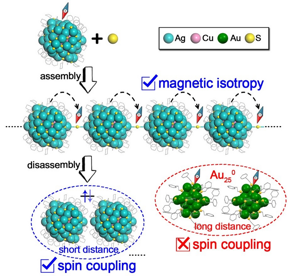 The magnetism performances of Ag77Cu22 nanoclusters after assembly and disassembly (The inset in red circle presents the absence of spin coupling in Au250 due to the long interparticle distance)
CREDIT
XIA Nan
The magnetism performances of Ag77Cu22 nanoclusters after assembly and disassembly (The inset in red circle presents the absence of spin coupling in Au250 due to the long interparticle distance)
CREDIT
XIA Nan
Abstract: In a recent paper published in Nature Communications, a team led by Prof. WU Zhikun from the Institute of Solid State Physics, Hefei Institutes of Physical Science (HFIPS) of the Chinese Academy of Sciences (CAS), collaborated with Prof. ZENG Zhi group from the same institute and Prof. ZHAO Jijun group from Dalian University of Technology, discovered the spin transfer and spin coupling through the linear assembly of Ag-Cu alloy nanoclusters with sulfur.
Hefei, China | Posted on November 4th, 2022
The assembly of metal nanoparticles not only enriches their properties, but also helps to understand the structure-property relationships and the interactions between nanoparticles. However, due to the multi-distribution of metal nanocrystals, it is difficult to obtain atomically precise assembly structures; The recently emerging nanoclusters (ultrasmall nanoparticles)provide ideal building blocks for precise assembly due to their well-defined compositions and structures, however, few studies on atomically precise metal nanocluster (larger than 1 nm) assembly have been reported owing to the difficulty of synthesis and characterization.
In this study, the team prepared a linear assembly structure formed by linking two Ag77Cu22 clusters with one sulfur ion using a simultaneous synthesis and assembly strategy. The sulfur ions can be produced by the cleavage of carbon-sulfur and sulfur-hydrogen bonds of the thiols during the synthesis of the clusters, leading to the immediate link with clusters to form the assemblies.
Further studies showed that the magnetic moment in this linear assembled structure was transferred from the cluster to the sulfur, forming paramagnetic sulfur radicals, which exhibited magnetic isotropy due to the small spin-orbit coupling constants of sulfur and the absence of magnetic moment interaction between distant sulfur radicals. When the linear structures were disassembled in solution, the magnetic moment transferred back to the clusters, and subsequently spin coupling occurred. Notably, such spin coupling had not been reported in the magnetic Au250 clusters, which was interpreted by the interparticle distance dependent spin coupling. When the ligands were flexible and their lengths were short, the clusters could approach each other and the spin coupling occured within a certain distance. Otherwise it was difficult for the clusters to come close for coupling.
This work successfully achieved the linear assembly of the metal nanoclusters larger than 1 nm by using the adequate assembly strategy. It discovered and explained the spin transfer and distance-dependent spin coupling, which would have important implications for the future study of nanocluster magnetism and development of novel functional materials.
####
For more information, please click here
Contacts:Weiwei ZhaoHefei Institutes of Physical Science, Chinese Academy of Sciences
Office: 86-551-655-91206
Copyright © Hefei Institutes of Physical Science, Chinese Academy of Sciences
If you have a comment, please Contact us.
Issuers of news releases, not 7th Wave, Inc. or Nanotechnology Now, are solely responsible for the accuracy of the content.
Bookmark:


News and information
 HKUST researchers develop a novel integration scheme for efficient coupling between III-V and silicon November 18th, 2022
Researchers at Purdue unlock light-matter interactions on sub-nanometer scales, leading to �picophotonics� November 18th, 2022
Rice turns asphaltene into graphene for composites: �Flashed� byproduct of crude oil could bolster materials, polymer inks November 18th, 2022
How �2D� materials expand: New technique that accurately measures how atom-thin materials expand when heated could help engineers develop faster, more powerful electronic devices November 18th, 2022
Govt.-Legislation/Regulation/Funding/Policy
NIST�s grid of quantum islands could reveal secrets for powerful technologies November 18th, 2022
How �2D� materials expand: New technique that accurately measures how atom-thin materials expand when heated could help engineers develop faster, more powerful electronic devices November 18th, 2022
Possible Futures
HKUST researchers develop a novel integration scheme for efficient coupling between III-V and silicon November 18th, 2022
NIST�s grid of quantum islands could reveal secrets for powerful technologies November 18th, 2022
Spintronics
Spin photonics to move forward with new anapole probe November 4th, 2022
Novel nanowire fabrication technique paves way for next generation spintronics November 4th, 2022
�Kagome� metallic crystal adds new spin to electronics October 28th, 2022
Liquid crystal templated chiral nanomaterials October 14th, 2022
Chip Technology
NIST�s grid of quantum islands could reveal secrets for powerful technologies November 18th, 2022
An on-chip time-lens generates ultrafast pulses: New device opens the doors to applications in communication, quantum computing, astronomy November 18th, 2022
Researchers at Purdue unlock light-matter interactions on sub-nanometer scales, leading to �picophotonics� November 18th, 2022
Semi-nonlinear etchless lithium niobate waveguide with bound states in the continuum November 4th, 2022
Quantum Computing
NIST�s grid of quantum islands could reveal secrets for powerful technologies November 18th, 2022
Novel nanowire fabrication technique paves way for next generation spintronics November 4th, 2022
Discoveries
An on-chip time-lens generates ultrafast pulses: New device opens the doors to applications in communication, quantum computing, astronomy November 18th, 2022
Researchers at Purdue unlock light-matter interactions on sub-nanometer scales, leading to �picophotonics� November 18th, 2022
Rice turns asphaltene into graphene for composites: �Flashed� byproduct of crude oil could bolster materials, polymer inks November 18th, 2022
How �2D� materials expand: New technique that accurately measures how atom-thin materials expand when heated could help engineers develop faster, more powerful electronic devices November 18th, 2022
Materials/Metamaterials
Rice turns asphaltene into graphene for composites: �Flashed� byproduct of crude oil could bolster materials, polymer inks November 18th, 2022
How �2D� materials expand: New technique that accurately measures how atom-thin materials expand when heated could help engineers develop faster, more powerful electronic devices November 18th, 2022
Semi-nonlinear etchless lithium niobate waveguide with bound states in the continuum November 4th, 2022
Announcements
HKUST researchers develop a novel integration scheme for efficient coupling between III-V and silicon November 18th, 2022
NIST�s grid of quantum islands could reveal secrets for powerful technologies November 18th, 2022
How �2D� materials expand: New technique that accurately measures how atom-thin materials expand when heated could help engineers develop faster, more powerful electronic devices November 18th, 2022
Interviews/Book Reviews/Essays/Reports/Podcasts/Journals/White papers/Posters
An on-chip time-lens generates ultrafast pulses: New device opens the doors to applications in communication, quantum computing, astronomy November 18th, 2022
Researchers at Purdue unlock light-matter interactions on sub-nanometer scales, leading to �picophotonics� November 18th, 2022
Rice turns asphaltene into graphene for composites: �Flashed� byproduct of crude oil could bolster materials, polymer inks November 18th, 2022
How �2D� materials expand: New technique that accurately measures how atom-thin materials expand when heated could help engineers develop faster, more powerful electronic devices November 18th, 2022
