
| Date | 5th, Nov 2022 |
|---|
Home > Press > New study introduces the best graphite films: The work by Distinguished Professor Feng Ding at UNIST has been published in the October 2022 issue of Nature Nanotechnology
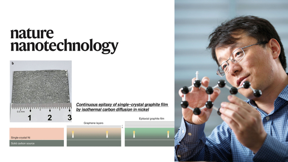 Distinguished Professor Feng Ding at UNIST
CREDIT
Hong Beom Ahn
Distinguished Professor Feng Ding at UNIST
CREDIT
Hong Beom Ahn
Abstract: High-quality graphite has excellent mechanical strength, thermal stability, high flexibility and very high in-plane thermal and electric conductivities and, thus, is one of most important advanced materials for many applications, such as being used as the light thermal conductor of cell phones. For example, a specific type of graphite, Highly Ordered Pyrolytic Graphite (HOPG), is one of the mostly used lab. materials. These excellent properties originate from the layered structure of graphite, where the strong covalent binding between carbon atoms in a graphene layer contribute to the excellent mechanical properties, thermal and electric conductivities and the very weak interaction between graphene layers leads to the highly flexibility of graphite.
Ulsan, Korea | Posted on November 4th, 2022
Although graphite has been discovered in Nature for more 1000 years and its artificial synthesis has been explored for more than 100 years, the quality of graphite samples, either Natural ones or synthesized ones, are far from ideal. Such as the size of the largest single crystalline graphite domains in graphitic materials are generally less than 1 mm, which is in sharp contrast to the size of many crystals, such as the size of quartz single crystal and silicon single crystals may reach meter scale. The very small size of single crystalline graphite is due to the weak interaction between graphite layers, where the flatness of a graphene layer is hard to be maintained during the growth process and, thus, a graphite can be easily breaks into a few single crystals with disordered grain boundaries (See Figure 1).
To solve the critical issue, Distinguished Professor of Ulsan National Institute of Science and Technology (UNIST) and his collaborators, Professor Kaihui Liu, Professor Enge Wang of Peking University, and others has proposed a strategy to synthesize single-crystalline graphite films orders of magnitude large, up to inch scale. In their approach, single crystalline Ni foils are used as a substrate and caron atoms are supplied from the back side of the Ni foils through an �isothermal dissolution-diffusion-precipitation process� (See Figure 2). Instead of using gas phase carton source, they choose solid carbon materials to feed the graphite growth. Such a new strategy allows of ~1 inch single crystalline graphite films of 35 μm thick, or more than 100,000 graphene layers, within a few days. The single crystalline graphite has the recorded thermal conductivity of ~2,880 Wm-1K-1, negligible impurity contents and smallest layer distances in compare with all available graphite samples.
�This success really on a few critical issues of the experimental design: (1) the successful synthesis of large size single crystalline Ni films serves as an ultra-flat substrate and thus the disorders in the synthesized graphite can be avoided; (2) the isothermal growth of 100,000 graphene layers over ~ 100 hours allows every graphene layer be synthesized under exact same chemical environment and temperature thus ensure the uniformity of the graphite quality; (3) continuous carbon feeding through the back side of the Ni foil allows the contiguous growth of graphene layers in a very large growth rate, ~ one layer per five seconds,� Professor Ding explained.
The findings of this research have been published in the October 2022 issue of Nature Nanotechnology. This study has been jointly participated by Professor Kaihui Liu and Professor Enge Wang from Peking University.
####
For more information, please click here
Contacts:JooHyeon HeoUlsan National Institute of Science and Technology(UNIST)
Office: +82-52-217-1223
Copyright © Ulsan National Institute of Science and Technology(UNIST)
If you have a comment, please Contact us.
Issuers of news releases, not 7th Wave, Inc. or Nanotechnology Now, are solely responsible for the accuracy of the content.
Bookmark:


News and information
 HKUST researchers develop a novel integration scheme for efficient coupling between III-V and silicon November 18th, 2022
Researchers at Purdue unlock light-matter interactions on sub-nanometer scales, leading to �picophotonics� November 18th, 2022
2 Dimensional Materials
NIST�s grid of quantum islands could reveal secrets for powerful technologies November 18th, 2022
Rice turns asphaltene into graphene for composites: �Flashed� byproduct of crude oil could bolster materials, polymer inks November 18th, 2022
Graphene/ Graphite
Rice turns asphaltene into graphene for composites: �Flashed� byproduct of crude oil could bolster materials, polymer inks November 18th, 2022
Thin films
Thin-film, high-frequency antenna array offers new flexibility for wireless communications November 5th, 2021
Leibniz Prize winner Professor Dr. Oliver G. Schmidt moves to Chemnitz University of Technology: President Professor Dr. Gerd Strohmeier refers to an 'absolute top transfer' September 10th, 2021
Possible Futures
HKUST researchers develop a novel integration scheme for efficient coupling between III-V and silicon November 18th, 2022
NIST�s grid of quantum islands could reveal secrets for powerful technologies November 18th, 2022
Discoveries
An on-chip time-lens generates ultrafast pulses: New device opens the doors to applications in communication, quantum computing, astronomy November 18th, 2022
Researchers at Purdue unlock light-matter interactions on sub-nanometer scales, leading to �picophotonics� November 18th, 2022
Rice turns asphaltene into graphene for composites: �Flashed� byproduct of crude oil could bolster materials, polymer inks November 18th, 2022
How �2D� materials expand: New technique that accurately measures how atom-thin materials expand when heated could help engineers develop faster, more powerful electronic devices November 18th, 2022
Announcements
HKUST researchers develop a novel integration scheme for efficient coupling between III-V and silicon November 18th, 2022
NIST�s grid of quantum islands could reveal secrets for powerful technologies November 18th, 2022
How �2D� materials expand: New technique that accurately measures how atom-thin materials expand when heated could help engineers develop faster, more powerful electronic devices November 18th, 2022
Interviews/Book Reviews/Essays/Reports/Podcasts/Journals/White papers/Posters
An on-chip time-lens generates ultrafast pulses: New device opens the doors to applications in communication, quantum computing, astronomy November 18th, 2022
Researchers at Purdue unlock light-matter interactions on sub-nanometer scales, leading to �picophotonics� November 18th, 2022
Rice turns asphaltene into graphene for composites: �Flashed� byproduct of crude oil could bolster materials, polymer inks November 18th, 2022
How �2D� materials expand: New technique that accurately measures how atom-thin materials expand when heated could help engineers develop faster, more powerful electronic devices November 18th, 2022
