
| Date | 28th, Nov 2022 |
|---|
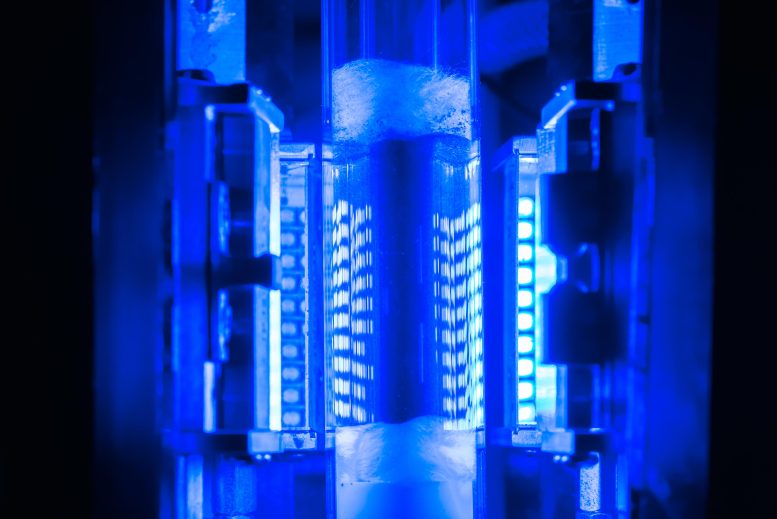
A reaction cell tests copper-iron plasmonic photocatalysts for hydrogen production from ammonia. Credit: Brandon Martin/Rice University
A key light-activated nanomaterial for the hydrogen economy has been engineered by researchers at Rice University. Using only inexpensive raw materials, scientists created a scalable catalyst that needs only the power of light to convert ammonia into clean-burning hydrogen fuel.
“This discovery paves the way for sustainable, low-cost hydrogen that could be produced locally rather than in massive centralized plants.” — Peter Nordlander
The research, which was published on November 24 in the journal Science, was conducted by a team from Rice’s Laboratory for Nanophotonics, Syzygy Plasmonics Inc., and Princeton University’s Andlinger Center for Energy and the Environment.
Recent government and industry investments to create infrastructure and markets for carbon-free liquid ammonia fuel that will not contribute to greenhouse warming synergize nicely with this research. Because it is easy to transport and packs a lot of energy, with one nitrogen and three hydrogen atoms per molecule, liquid ammonia is a promising clean fuel of the future.
The new catalyst breaks those ammonia molecules (NH3) into hydrogen gas (H2), a clean-burning fuel, and nitrogen gas (N2), the largest component of Earth’s atmosphere. And unlike traditional catalysts, it doesn’t require heat. Instead, it harvests energy from light, either sunlight or energy-efficient LEDs.
