
One of the most pressing questions for the future is how these technologies can be adapted to quantum systems. Future applications of quantum technology require flexible architectures to overcome limitations of current devices such as limited tunability or a lack of built-in quantum light sources. On-chip generation of single photons is necessary to avoid the inevitable coupling losses incurred when using an off-chip source.
A team of researchers has demonstrated control of individual light quanta, at an extremely high degree of precision, using sound waves to switch individual photons on a chip back and forth between two outputs at gigahertz frequencies. The method can be used in acoustic quantum technologies or complex integrated photonic networks.
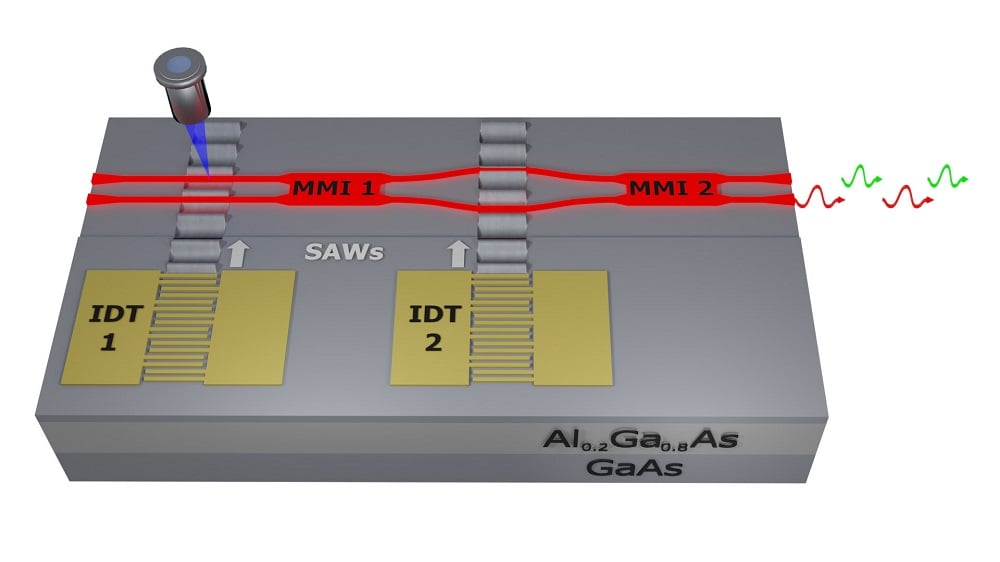
The researchers fabricated a dynamically reconfigurable integrated photonic circuit comprising a Mach-Zender interferometer and surface acoustic wave (SAW) transducers, directly on a monolithic semiconductor platform. In the system, the SAWs dynamically strained the waveguides, which were approximately 30× thinner than a human hair.
In addition, the circuit comprised an integrated quantum light source, in the form of quantum dots.
“These quantum dots, just a few nanometers in size, are islands inside the waveguides which emit light as individual photons,” said Matthias Weiß, a researcher at the University of Münster. “The quantum dots are included in our chip and so we don’t have to use complicated methods to generate individual photons by means of another source.”
Using nanoscale sound waves, the researchers directly switched the photons on the chip back and forth between two outputs at unprecedented speed as they propagated the waveguides, said Dominik Bühler, who designed the quantum chips as part of his Ph.D. at the University of Valencia.
The team believes its results to be a milestone on the way toward hybrid quantum technologies, as they combine three quantum systems: a quantum light source in the form of quantum dots; the light quanta created; and phonons, the quantum particles in the sound wave.
The team has taken a further step toward acoustic quantum technologies. Mauricio de Lima, a researcher at the University of Valencia, said, “We are already working flat out to enhance our chip so that we can program the quantum state of the photons as we wish, or even control several photons with different colors between four or more outputs.”
The research was published in Nature Communications (www.doi.org/10.1038/s41467-022-34372-9).
