
| Date | 9th, Dec 2022 |
|---|
Home > Press > Scientist mimic nature to make nano particle metallic snowflakes: Scientists in New Zealand and Australia working at the level of atoms created something unexpected: tiny metallic snowflakes
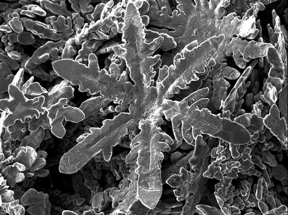 Nano-scale snowflake from Gallium solvent
CREDIT
Image: Waipapa Taumata Rau, University of Auckland
Nano-scale snowflake from Gallium solvent
CREDIT
Image: Waipapa Taumata Rau, University of Auckland
Abstract: Scientists in New Zealand and Australia working at the level of atoms created something unexpected: tiny metallic snowflakes.Why�s that significant? Because coaxing individual atoms to cooperate in desired ways is leading to a revolution in engineering and technology via nanomaterials (And creating snowflakes is cool.)
Auckland, New Zealand | Posted on December 9th, 2022
Nanoscale structures (a nanometre is one billionth of a metre) can aid electronic manufacturing, make materials stronger yet lighter, or aid environmental clean-ups by binding to toxins.
To create metallic nanocrystals, New Zealand and Australian scientists have been experimenting with gallium, a soft, silvery metal which is used in semiconductors and, unusually, liquifies at just above room temperature. Their results were just reported in the journal Science.
Professor Nicola Gaston and research fellow Dr Steph Lambie, both of Waipapa Taumata Rau, University of Auckland, and Dr Krista Steenbergen of Te Herenga Waka, Victoria University of Wellington, collaborated with colleagues in Australia led by Professor Kourosh Kalantar-Zadeh at the University of New South Wales.
The Australian team worked in the lab with nickel, copper, zinc, tin, platinum, bismuth, silver and aluminium, growing metal crystals in a liquid solvent of gallium. Metals were dissolved in gallium at high temperatures. Once cooled, the metallic crystals emerged while the gallium remained liquid. The New Zealand team, part of the MacDiarmid Institute for Advanced Materials and Nanotechnology, a national Centre of Research Excellence, carried out simulations of molecular dynamics to explain why differently shaped crystals emerge from different metals. (The government�s Marsden Fund supported the research.)
�What we are learning is that the structure of the liquid gallium is very important,� says Gaston. �That�s novel because we usually think of liquids as lacking structure or being only randomly structured.� Interactions between the atomistic structures of the different metals and the liquid gallium cause differently shaped crystals to emerge, the scientists showed.
The crystals included cubes, rods, hexagonal plates and the zinc snowflake shapes. The six-branched symmetry of zinc, with each atom surrounded by six neighbours at equivalent distances, accounts for the snowflake design. �In contrast to top-down approaches to forming nanostructure � by cutting away material � this bottom-up approaches relies on atoms self-assembling,� says Gaston. �This is how nature makes nanoparticles, and is both less wasteful and much more precise than top-down methods.� She says the research has opened up a new, unexplored pathway for metallic nanostructures. �There�s also something very cool in creating a metallic snowflake!�
####
For more information, please click here
Contacts:Gilbert WongUniversity of Auckland
Office: 0064-219-17942
Copyright © University of Auckland
If you have a comment, please Contact us.
Issuers of news releases, not 7th Wave, Inc. or Nanotechnology Now, are solely responsible for the accuracy of the content.
Bookmark:


News and information
 Shrinking hydrogels enlarge nanofabrication options: Researchers from Pittsburgh and Hong Kong print intricate, 2D and 3D patterns December 29th, 2022
New method addresses problem with perovskite solar cells: NREL researchers provide growth approach that boosts efficiency, stability December 29th, 2022
New X-ray imaging technique to study the transient phases of quantum materials December 29th, 2022
The National Space Society Congratulates NASA on the Success of Artemis I Same-day Launch of the Hakuto-R Lunar Landing Mission will Help Support Future Lunar Crews December 12th, 2022
Nanofabrication
Shrinking hydrogels enlarge nanofabrication options: Researchers from Pittsburgh and Hong Kong print intricate, 2D and 3D patterns December 29th, 2022
Possible Futures
Shrinking hydrogels enlarge nanofabrication options: Researchers from Pittsburgh and Hong Kong print intricate, 2D and 3D patterns December 29th, 2022
New method addresses problem with perovskite solar cells: NREL researchers provide growth approach that boosts efficiency, stability December 29th, 2022
New X-ray imaging technique to study the transient phases of quantum materials December 29th, 2022
The National Space Society Congratulates NASA on the Success of Artemis I Same-day Launch of the Hakuto-R Lunar Landing Mission will Help Support Future Lunar Crews December 12th, 2022
Molecular Nanotechnology
First electric nanomotor made from DNA material: Synthetic rotary motors at the nanoscale perform mechanical work July 22nd, 2022
Nanotech scientists create world's smallest origami bird March 17th, 2021
Light-controlled nanomachine controls catalysis: A molecular motor enables the speed of chemical processes to be controlled using light impulses November 23rd, 2020
Discoveries
Shrinking hydrogels enlarge nanofabrication options: Researchers from Pittsburgh and Hong Kong print intricate, 2D and 3D patterns December 29th, 2022
New method addresses problem with perovskite solar cells: NREL researchers provide growth approach that boosts efficiency, stability December 29th, 2022
New X-ray imaging technique to study the transient phases of quantum materials December 29th, 2022
The National Space Society Congratulates NASA on the Success of Artemis I Same-day Launch of the Hakuto-R Lunar Landing Mission will Help Support Future Lunar Crews December 12th, 2022
Announcements
Shrinking hydrogels enlarge nanofabrication options: Researchers from Pittsburgh and Hong Kong print intricate, 2D and 3D patterns December 29th, 2022
New method addresses problem with perovskite solar cells: NREL researchers provide growth approach that boosts efficiency, stability December 29th, 2022
New X-ray imaging technique to study the transient phases of quantum materials December 29th, 2022
The National Space Society Congratulates NASA on the Success of Artemis I Same-day Launch of the Hakuto-R Lunar Landing Mission will Help Support Future Lunar Crews December 12th, 2022
Interviews/Book Reviews/Essays/Reports/Podcasts/Journals/White papers/Posters
Shrinking hydrogels enlarge nanofabrication options: Researchers from Pittsburgh and Hong Kong print intricate, 2D and 3D patterns December 29th, 2022
New method addresses problem with perovskite solar cells: NREL researchers provide growth approach that boosts efficiency, stability December 29th, 2022
New X-ray imaging technique to study the transient phases of quantum materials December 29th, 2022
Tin selenide nanosheets enables to develop wearable tracking devices December 9th, 2022
