
| Date | 9th, Dec 2022 |
|---|
Home > Press > Tin selenide nanosheets enables to develop wearable tracking devices
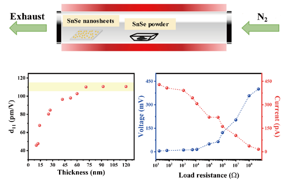 Tin selenide nanosheets enables to develope wearable tracking devices.
CREDIT
Nano Research, Tsinghua University Press
Tin selenide nanosheets enables to develope wearable tracking devices.
CREDIT
Nano Research, Tsinghua University Press
Abstract: Researchers have synthesized two-dimensional (2D) tin selenide (SnSe) nanosheets with remarkable piezoelectricity�turning mechanical stress into electricity�that enables to develop self-power wearable health tracking devices with no need for batteries.
Tsinghua, China | Posted on December 9th, 2022
If you have ever used a microphone, told time on a quartz watch, or listened to a speaker, you have been witness to the piezoelectric effect, or converting mechanical stress into electricity (or vice versa).
Electric charge can accumulate in the crystal lattices of certain solid materials simply by applying a mechanical force to them, such as squeezing or pushing. This remarkable property does not affect all solids, but only occurs when a solid�s crystal structure is such that when mechanical stress is applied, some atoms get pushed together or further apart, destabilizing the balance between positive and negative electric charge. This deformation makes the crystal capable of conducting an electric current.
This piezoelectric effect plays a key role in functional sensors, wearable electronics and microelectromechanical systems. But the materials used for these �piezotronic devices� tend to be large, bulk volumes of crystal structure, limiting their flexibility.
Recently, however, so-called 2D materials�those that are just a handful of atoms thick�have emerged as a promising candidate for flexible piezotronics. The flexibility comes from the atomic-scale thinness of these piezoelectric nanogenerators, or �PENGs�, and theoretical analysis suggests that 2D materials exhibit an even stronger piezoelectric effect than commonly used bulk piezoelectric materials such as quartz.
�But what is predicted by theory in a computer runs into trouble once such materials are used in the real world,� said Prof. Jianhua Hao, a material scientist at Hong Kong Polytechnic University and corresponding author of the paper.
A considerable amount of effort has gone into exploring the piezoelectric properties of many materials, including 2D semiconductors such as hexagonal boron nitride and transition-metal dichalcogenides. But it turns out that the piezoelectricity only occurs when these materials exist in single layers (or �monolayers�). The piezoelectric effect disappears as one layer�s electronic polarization gets cancelled out by its adjacent layers� polarization in the opposite direction. This severely limits the applicability of 2D piezotronics due to the poor mechanical durability of monolayers.
Some researchers have tried to get around this problem by various strategies, such as using novel stacking configurations for the layers.
�But the piezoelectric performance is extremely weak,� added Prof. Hao. �And perhaps even more importantly, the engineering process is just very complicated and not easily controllable, making them not particularly economically competitive with existing piezotronic materials for most practical applications.�
But one group of 2D materials, monochalcogenides from groups IV-VI of the periodic table (binary compounds that pair tin or germanium with selenium or sulfur), have intrinsically high piezoelectric capability. This impressive performance comes from a buckled or �puckered� structure of the crystal. Tin selenide in particular combines good piezoelectric capability with robust mechanical durability.
So many researchers have put their eyes on developing SnSe films using mechanical exfoliation and solution mediated growth technique. These were then used for PENGs in self-powered pH sensors and finger-force monitors.
�Unfortunately, these synthesis methods ran into some troubles with sample quality too,� continued Prof. Hao. �The technique limits the lateral size, or area, of PENG that can be produced, so it�s not very scalable. And it�s not very controllable either.�
So the researchers wanted to see if chemical vapor deposition (CVD) might work. This technique, commonly used in the conventional semiconductor industry, and enjoys strong scalability, controllability and thus capacity for mass production, involves exposure of the given substance (in this case the tin selenide compound) to a vapor that reacts with the substance and subsequently produces a thin film deposit.
The researchers deployed this technique to produce multi-layer SnSe nanosheets of varying thicknesses and then tested their performance via a piezoresponse force microscope. The best performing one achieved energy conversion efficiency far higher than PENGS made of all previously used materials. This was then developed into a PENG and used in a self-powered sensor to monitor human motion�a device attached to the finger and wrist of a human tester, thus testing its flexibility.
The device not only continued its excellent piezoelectric output, but demonstrated the requisite flexibility and durability for a wearable device.
The research team now hope to take their proof of concept and develop it into commercially viable self-powered and wearable health-tracking devices.
####
About Tsinghua University PressEstablished in 1980, belonging to Tsinghua University, Tsinghua University Press (TUP) is a leading comprehensive higher education and professional publisher in China. Committed to building a top-level global cultural brand, after 41 years of development, TUP has established an outstanding managerial system and enterprise structure, and delivered multimedia and multi-dimensional publications covering books, audio, video, electronic products, journals and digital publications. In addition, TUP actively carries out its strategic transformation from educational publishing to content development and service for teaching & learning and was named First-class National Publisher for achieving remarkable results.
About Nano Research
Nano Research is a peer-reviewed, international and interdisciplinary research journal, publishes all aspects of nano science and technology, featured in rapid review and fast publishing, sponsored by Tsinghua University and the Chinese Chemical Society. It offers readers an attractive mix of authoritative and comprehensive reviews and original cutting-edge research papers. After 15 years of development, it has become one of the most influential academic journals in the nano field. In 2022 InCites Journal Citation Reports, Nano Research has an Impact Factor of 10.269 (9.136, 5 years), the total cites reached 29620, ranking first in China's international academic journals, and the number of highly cited papers reached 120, ranked among the top 2.8% of over 9000 academic journals.
For more information, please click here
Contacts:Yao MengTsinghua University Press
Office: 86-108-347-0574
Copyright © Tsinghua University Press
If you have a comment, please Contact us.
Issuers of news releases, not 7th Wave, Inc. or Nanotechnology Now, are solely responsible for the accuracy of the content.
Bookmark:


News and information
 Shrinking hydrogels enlarge nanofabrication options: Researchers from Pittsburgh and Hong Kong print intricate, 2D and 3D patterns December 29th, 2022
New method addresses problem with perovskite solar cells: NREL researchers provide growth approach that boosts efficiency, stability December 29th, 2022
New X-ray imaging technique to study the transient phases of quantum materials December 29th, 2022
The National Space Society Congratulates NASA on the Success of Artemis I Same-day Launch of the Hakuto-R Lunar Landing Mission will Help Support Future Lunar Crews December 12th, 2022
Wearable electronics
Underwater movement sensor alerts when a swimmer might be drowning October 7th, 2022
Disposable electronics on a simple sheet of paper October 7th, 2022
Researchers design new inks for 3D-printable wearable bioelectronics: Potential uses include printing electronic tattoos for medical tracking applications August 19th, 2022
Flexible Electronics
Disposable electronics on a simple sheet of paper October 7th, 2022
Researchers design new inks for 3D-printable wearable bioelectronics: Potential uses include printing electronic tattoos for medical tracking applications August 19th, 2022
Govt.-Legislation/Regulation/Funding/Policy
New method addresses problem with perovskite solar cells: NREL researchers provide growth approach that boosts efficiency, stability December 29th, 2022
Experimental nanosheet material marks a step toward the next generation of low-power, high-performance electronics December 9th, 2022
New method of reducing carbon dioxide could be a golden solution to pollution December 9th, 2022
Possible Futures
Shrinking hydrogels enlarge nanofabrication options: Researchers from Pittsburgh and Hong Kong print intricate, 2D and 3D patterns December 29th, 2022
New method addresses problem with perovskite solar cells: NREL researchers provide growth approach that boosts efficiency, stability December 29th, 2022
New X-ray imaging technique to study the transient phases of quantum materials December 29th, 2022
The National Space Society Congratulates NASA on the Success of Artemis I Same-day Launch of the Hakuto-R Lunar Landing Mission will Help Support Future Lunar Crews December 12th, 2022
Chip Technology
New X-ray imaging technique to study the transient phases of quantum materials December 29th, 2022
Experimental nanosheet material marks a step toward the next generation of low-power, high-performance electronics December 9th, 2022
NIST�s grid of quantum islands could reveal secrets for powerful technologies November 18th, 2022
An on-chip time-lens generates ultrafast pulses: New device opens the doors to applications in communication, quantum computing, astronomy November 18th, 2022
Sensors
Spin photonics to move forward with new anapole probe November 4th, 2022
Highly sensitive and fast response strain sensor based on evanescently coupled micro/nanofibers October 14th, 2022
Taking salt out of the water equation October 7th, 2022
Discoveries
Shrinking hydrogels enlarge nanofabrication options: Researchers from Pittsburgh and Hong Kong print intricate, 2D and 3D patterns December 29th, 2022
New method addresses problem with perovskite solar cells: NREL researchers provide growth approach that boosts efficiency, stability December 29th, 2022
New X-ray imaging technique to study the transient phases of quantum materials December 29th, 2022
The National Space Society Congratulates NASA on the Success of Artemis I Same-day Launch of the Hakuto-R Lunar Landing Mission will Help Support Future Lunar Crews December 12th, 2022
Announcements
Shrinking hydrogels enlarge nanofabrication options: Researchers from Pittsburgh and Hong Kong print intricate, 2D and 3D patterns December 29th, 2022
New method addresses problem with perovskite solar cells: NREL researchers provide growth approach that boosts efficiency, stability December 29th, 2022
New X-ray imaging technique to study the transient phases of quantum materials December 29th, 2022
The National Space Society Congratulates NASA on the Success of Artemis I Same-day Launch of the Hakuto-R Lunar Landing Mission will Help Support Future Lunar Crews December 12th, 2022
Interviews/Book Reviews/Essays/Reports/Podcasts/Journals/White papers/Posters
Shrinking hydrogels enlarge nanofabrication options: Researchers from Pittsburgh and Hong Kong print intricate, 2D and 3D patterns December 29th, 2022
New method addresses problem with perovskite solar cells: NREL researchers provide growth approach that boosts efficiency, stability December 29th, 2022
New X-ray imaging technique to study the transient phases of quantum materials December 29th, 2022
New method of reducing carbon dioxide could be a golden solution to pollution December 9th, 2022
Battery Technology/Capacitors/Generators/Piezoelectrics/Thermoelectrics/Energy storage
Semi-nonlinear etchless lithium niobate waveguide with bound states in the continuum November 4th, 2022
Advances in thermoelectric power generation possible with various �metal chalcogenide� materials, recent review shows November 4th, 2022
Improving the efficiency of nanogenerators that harvest static electricity October 28th, 2022
The battery that runs 630 km on a single charge October 7th, 2022
