
| Date | 7th, Jan 2023 |
|---|
Home > Press > Dawn of solid-state quantum networks: Researchers demonstrated high-visibility quantum interference between two independent semiconductor quantum dots � an important step toward scalable quantum networks
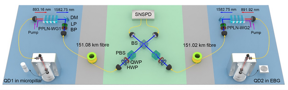 Experimental configuration of quantum interference between two independent solid-state QD single-photon sources separated by 302 km fiber. DM: dichromatic mirror, LP: long pass, BP: band pass, BS: beam splitter, SNSPD: superconducting nanowire single- photon detector, HWP: half-wave plate, QWP: quarter-wave plate, PBS: polarization beam splitter.
CREDIT
You et al., doi 10.1117/1.AP.4.6.066003
Experimental configuration of quantum interference between two independent solid-state QD single-photon sources separated by 302 km fiber. DM: dichromatic mirror, LP: long pass, BP: band pass, BS: beam splitter, SNSPD: superconducting nanowire single- photon detector, HWP: half-wave plate, QWP: quarter-wave plate, PBS: polarization beam splitter.
CREDIT
You et al., doi 10.1117/1.AP.4.6.066003
Abstract: This year�s Nobel Prize in Physics celebrated the fundamental interest of quantum entanglement, and also envisioned the potential applications in �the second quantum revolution� � a new age when we are able to manipulate the weirdness of quantum mechanics, including quantum superposition and entanglement. A large-scale and fully functional quantum network is the holy grail of quantum information sciences. It will open a new frontier of physics, with new possibilities for quantum computation, communication, and metrology.
Bellingham, WA | Posted on January 6th, 2023
One of the most significant challenges is to extend the distance of quantum communication to a practically useful scale. Unlike classical signals that can be noiselessly amplified, quantum states in superposition cannot be amplified because they cannot be perfectly cloned. Therefore, a high-performance quantum network requires not only ultra-low-loss quantum channels and quantum memory, but also high-performance quantum light sources. There has been exciting recent progress in satellite-based quantum communications and quantum repeaters, but a lack of suitable single-photon sources has hampered further advances.
What is required of a single-photon source for quantum network applications? First, it should emit one (only one) photon at a time. Second, to attain brightness, the single-photon sources should have high system efficiency and a high repetition rate. Third, for applications such as in quantum teleportation that require interfering with independent photons, the single photons should be indistinguishable. Additional requirements include a scalable platform, tunable and narrowband linewidth (favorable for temporal synchronization), and interconnectivity with matter qubits.
A promising source is quantum dots (QDs), semiconductor particles of just a few nanometers. However, in the past two decades, the visibility of quantum interference between independent QDs has rarely exceeded the classical limit of 50% and distances have been limited to around a few meters or kilometers.
As reported in Advanced Photonics, an international team of researchers has achieved high-visibility quantum interference between two independent QDs linked with ~300 km optical fibers. They report efficient and indistinguishable single-photon sources with ultra-low-noise, tunable single-photon frequency conversion, and low-dispersion long fiber transmission. The single photons are generated from resonantly driven single QDs deterministically coupled to microcavities. Quantum frequency conversions are used to eliminate the QD inhomogeneity and shift the emission wavelength to the telecommunications band. The observed interference visibility is up to 93%. According to senior author Chao-Yang Lu, professor at the University of Science and Technology of China (USTC), �Feasible improvements can further extend the distance to ~600 km.�
Lu remarks, �Our work jumped from the previous QD-based quantum experiments at a scale from ~1 km to 300 km, two orders of magnitude larger, and thus opens an exciting prospect of solid-state quantum networks.� With this reported jump, the dawn of solid-state quantum networks may soon begin breaking toward day.
####
For more information, please click here
Contacts:Daneet SteffensSPIE--International Society for Optics and Photonics
Office: 360-685-5478
Copyright © SPIE--International Society for Optics and Photonics
If you have a comment, please Contact us.
Issuers of news releases, not 7th Wave, Inc. or Nanotechnology Now, are solely responsible for the accuracy of the content.
Bookmark:


News and information
 Graphene Flagship start-up Bedimensional closes a second �10 million investment round February 10th, 2023
Quantum Physics
New study opens the door to ultrafast 2D devices that use nonequilibrium exciton superdiffusion February 10th, 2023
Danish quantum physicists make nanoscopic advance of colossal significance January 27th, 2023
Quantum communication
Researchers demonstrate co-propagation of quantum and classical signals: Study shows that quantum encryption can be implemented in existing fiber networks January 20th, 2023
New X-ray imaging technique to study the transient phases of quantum materials December 29th, 2022
Quantum chemistry
New X-ray imaging technique to study the transient phases of quantum materials December 29th, 2022
Possible Futures
Make them thin enough, and antiferroelectric materials become ferroelectric February 10th, 2023
Quantum Computing
Qubits on strong stimulants: Researchers find ways to improve the storage time of quantum information in a spin rich material January 27th, 2023
Danish quantum physicists make nanoscopic advance of colossal significance January 27th, 2023
Discoveries
Make them thin enough, and antiferroelectric materials become ferroelectric February 10th, 2023
Announcements
Graphene Flagship start-up Bedimensional closes a second �10 million investment round February 10th, 2023
Fiber sensing scientists invent 3D printed fiber microprobe for measuring in vivo biomechanical properties of tissue and even single cell February 10th, 2023
Photonic Materials: Recent Advances and Emerging Applications February 10th, 2023
Make them thin enough, and antiferroelectric materials become ferroelectric February 10th, 2023
Interviews/Book Reviews/Essays/Reports/Podcasts/Journals/White papers/Posters
Make them thin enough, and antiferroelectric materials become ferroelectric February 10th, 2023
Quantum nanoscience
New study opens the door to ultrafast 2D devices that use nonequilibrium exciton superdiffusion February 10th, 2023
