
| Date | 4th, Mar 2023 |
|---|
Home > Press > Lipid nanoparticles highly effective in gene therapy
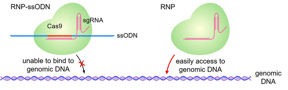 The RNP-ssODN is designed to ensure the CRISPR-Cas9 molecule is encapsulated by the LNP. Once inside the cells, the ssODN dissociates and CRISPR-Cas9 can carry out its effect. (Haruno Onuma, Yusuke Sato, Hideyoshi Harashima. Journal of Controlled Release. February 10, 2023).
CREDIT
Haruno Onuma, Yusuke Sato, Hideyoshi Harashima. Journal of Controlled Release. February 10, 2023
The RNP-ssODN is designed to ensure the CRISPR-Cas9 molecule is encapsulated by the LNP. Once inside the cells, the ssODN dissociates and CRISPR-Cas9 can carry out its effect. (Haruno Onuma, Yusuke Sato, Hideyoshi Harashima. Journal of Controlled Release. February 10, 2023).
CREDIT
Haruno Onuma, Yusuke Sato, Hideyoshi Harashima. Journal of Controlled Release. February 10, 2023
Abstract: Lipid nanoparticles have been used to encapsulate CRISPR-Cas9 and deliver it to cells in mice, where it was highly effective at knocking down expression of a target protein.
Hokkaido, Japan | Posted on March 3rd, 2023
Gene therapy is a potential mode of treatment for a wide variety of diseases caused by genetic mutations. While it has been an area of diverse and intense research, historically, only a very few patients have been treated using gene therapy�and fewer still cured. The advent of the genetic modification technique called CRISPR-Cas9 in 2012 has revolutionized gene therapy�as well as biology as a whole�and it has recently entered clinical trials for the treatment of some diseases in humans.
Haruno Onuma, Yusuke Sato and Hideyoshi Harashima at Hokkaido University have developed a new delivery system for CRISPR-Cas9, based on lipid nanoparticles (LNPs), that could greatly increases the efficiency of in vivo gene therapy. Their findings were published in the Journal of Controlled Release.
�There are broadly two ways of treating diseases with gene therapy,� Sato explained, �ex vivo, where cells are subjected to the desired modifications in the laboratory and then introduced into the patient, and in vivo, where the treatment is administered to the patient to change the cells in their body. Safe and effective in vivo treatment is the ultimate aspiration of gene therapy, as it would be a straightforward process for patients and healthcare providers. LNPs can function as a vehicle for the safe and effective delivery of such therapies.�
CRISPR-Cas9 consists of a large molecule composed of the Cas9 protein and guide RNA. The guide RNA binds to a specific, complementary DNA sequence, and the Cas9 protein cuts that sequence, allowing it to be modified. The guide RNA can be altered to target specific DNA sequences to be modified.
�In a previous study, we discovered that additional DNA molecules, called ssODNs, ensure that the CRISPR-Cas9 molecule is loaded into the LNPs (CRISPR-LNPs),� Harashima elucidated. �In this study, we again used ssODNs, but they were carefully designed so that they would not inhibit the function of the guide RNA.�
Using a guide RNA targeting the expression of a protein called transthyretin, they evaluated the effectiveness of the CRISPR-LNPs in mice models. CRISPR-LNPs with ssODNs that dissociated from the guide RNA at room temperature were most effective at reducing serum transthyretin: two consecutive doses, one day apart, reduced it by 80%.
�We have demonstrated the optimal ssODN sequence affinity that ensures the loading and the release of CRISPR-Cas9 at the target location; and that this system can be used to edit cells in vivo,� concluded Onuma. �We will continue to improve the design of ssODNs, as well as to develop optimal lipid formulations to increase the effectiveness of delivery.�
####
For more information, please click here
Contacts:Sohail Keegan PintoHokkaido University
Office: +81-11-706-2186
Copyright © Hokkaido University
If you have a comment, please Contact us.
Issuers of news releases, not 7th Wave, Inc. or Nanotechnology Now, are solely responsible for the accuracy of the content.
Bookmark:


News and information
 Optical switching at record speeds opens door for ultrafast, light-based electronics and computers: March 24th, 2023
Robot caterpillar demonstrates new approach to locomotion for soft robotics March 24th, 2023
Semiconductor lattice marries electrons and magnetic moments March 24th, 2023
Light meets deep learning: computing fast enough for next-gen AI March 24th, 2023
Possible Futures
New experiment translates quantum information between technologies in an important step for the quantum internet March 24th, 2023
Graphene grows � and we can see it March 24th, 2023
HKUMed invents a novel two-dimensional (2D) ultrasound-responsive antibacterial nano-sheets to effectively address bone tissue infection March 24th, 2023
A universal HCl-assistant powder-to-powder strategy for preparing lead-free perovskites March 24th, 2023
Nanomedicine
Getting drugs across the blood-brain barrier using nanoparticles March 3rd, 2023
Scientists push the boundaries of manipulating light at the submicroscopic level March 3rd, 2023
Discoveries
New experiment translates quantum information between technologies in an important step for the quantum internet March 24th, 2023
Graphene grows � and we can see it March 24th, 2023
HKUMed invents a novel two-dimensional (2D) ultrasound-responsive antibacterial nano-sheets to effectively address bone tissue infection March 24th, 2023
A universal HCl-assistant powder-to-powder strategy for preparing lead-free perovskites March 24th, 2023
Announcements
Robot caterpillar demonstrates new approach to locomotion for soft robotics March 24th, 2023
Semiconductor lattice marries electrons and magnetic moments March 24th, 2023
Light meets deep learning: computing fast enough for next-gen AI March 24th, 2023
Bilayer PET/PVDF substrate-reinforced solid polymer electrolyte improves solid-state lithium metal battery performance March 24th, 2023
Interviews/Book Reviews/Essays/Reports/Podcasts/Journals/White papers/Posters
HKUMed invents a novel two-dimensional (2D) ultrasound-responsive antibacterial nano-sheets to effectively address bone tissue infection March 24th, 2023
A universal HCl-assistant powder-to-powder strategy for preparing lead-free perovskites March 24th, 2023
Optical switching at record speeds opens door for ultrafast, light-based electronics and computers: March 24th, 2023
Robot caterpillar demonstrates new approach to locomotion for soft robotics March 24th, 2023
Nanobiotechnology
HKUMed invents a novel two-dimensional (2D) ultrasound-responsive antibacterial nano-sheets to effectively address bone tissue infection March 24th, 2023
Getting drugs across the blood-brain barrier using nanoparticles March 3rd, 2023
Scientists push the boundaries of manipulating light at the submicroscopic level March 3rd, 2023
