
Stimulated light emission, postulated by Einstein in 1916, is widely observed for large numbers of photons and laid the basis for the invention of the laser. With this research, stimulated emission has now been observed for single photons.
Specifically, the scientists could measure the direct time delay between one photon and a pair of bound photons scattering off a single quantum dot, a type of artificially created atom.
One of the advantages of using light in communication — through optical fibers — is that photons do not easily interact with one another. This creates near distortion-free transfer of information at the speed of light. Sometimes, however, interaction between photons is desirable, which can pose challenges.
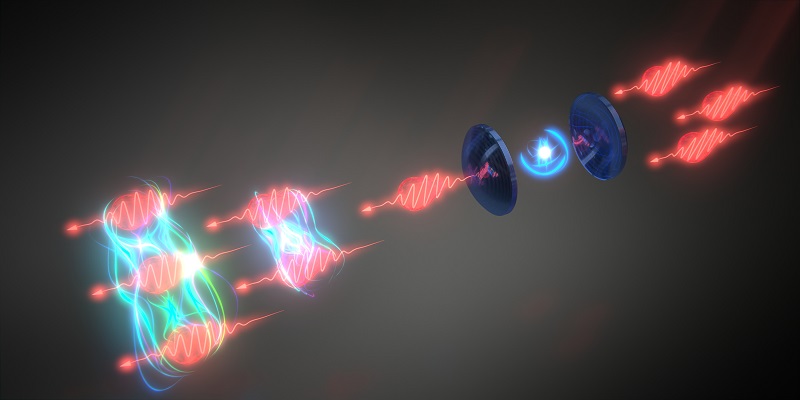
“The device we built induced such strong interactions between photons that we were able to observe the difference between one photon interacting with it compared to two,” said joint lead author and postdoctoral researcher Natasha Tomm of the University of Basel. “We observed that one photon was delayed by a longer time compared to two photons. With this really strong photon-photon interaction, the two photons become entangled in the form of what is called a two-photon bound state.”
The so-called quantum light can, in principle, make more sensitive measurements with better resolution using fewer photons. This can be important for applications in biological microscopy when large light intensities can damage samples and where the features to be observed are particularly small.
“By demonstrating that we can identify and manipulate photon-bound states, we have taken a vital first step toward harnessing quantum light for practical use,” said joint lead author Sahand Mahmoodian, a physics professor at the University of Sydney.
The next steps are to explore how the approach can be used to generate states of light useful for fault-tolerant quantum computing.
“This experiment is beautiful, not only because it validates a fundamental effect — stimulated emission — at its ultimate limit, but it also represents a huge technological step toward advanced applications,” Tomm said. “We can apply the same principles to develop more-efficient devices that give us photon bound states. This is very promising for applications in a wide range of areas: from biology to advanced manufacturing and quantum information processing.”
The research was a collaboration of the University of Basel, Leibniz University Hannover, the University of Sydney, and Ruhr University Bochum.
The research was published in Nature Physics (www.doi.org/10.1038/s41567-023-01997-6).
