
| Date | 24th, Mar 2023 |
|---|
Home > Press > New experiment translates quantum information between technologies in an important step for the quantum internet
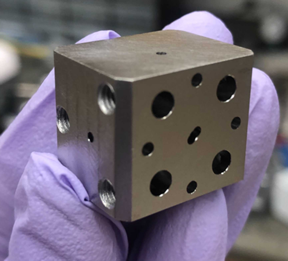 A niobium superconducting cavity. The holes lead to tunnels which intersect to trap light and atoms.
CREDIT
Aishwarya Kumar
A niobium superconducting cavity. The holes lead to tunnels which intersect to trap light and atoms.
CREDIT
Aishwarya Kumar
Abstract: Researchers have discovered a way to �translate� quantum information between different kinds of quantum technologies, with significant implications for quantum computing, communication, and networking.
Chicago, IL | Posted on March 24th, 2023
The research, published in the journal Nature on Wednesday, was funded by the Army Research Office (ARO), the Air Force Office of Scientific Research (AFOSR), and the NSF Quantum Leap Challenge Institute for Hybrid Quantum Architectures and Networks (HQAN), which is led by the University of Illinois Urbana-Champaign. It represents a new way to convert quantum information from the format used by quantum computers to the format needed for quantum communication.
Photons�particles of light�are essential for quantum information technologies, but different technologies use them at different frequencies. For example, some of the most common quantum computing technology is based on superconducting qubits, such as those used by tech giants Google and IBM; these qubits store quantum information in photons that move at microwave frequencies.
But if you want to build a quantum network, or connect quantum computers, you can�t send around microwave photons because their grip on their quantum information is too weak to survive the trip.
�A lot of the technologies that we use for classical communication�cell phones, Wi-Fi, GPS and things like that�all use microwave frequencies of light,� said Aishwarya Kumar, a postdoc at the James Franck Institute at University of Chicago and lead author on the paper. �But you can�t do that for quantum communication because the quantum information you need is in a single photon. And at microwave frequencies, that information will get buried in thermal noise.�
The solution is to transfer the quantum information to a higher-frequency photon, called an optical photon, which is much more resilient against ambient noise. But the information can�t be transferred directly from photon to photon; instead, we need intermediary matter. Some experiments design solid state devices for this purpose, but Kumar�s experiment aimed for something more fundamental: atoms.
The electrons in atoms are only ever allowed to have certain specific amounts of energy, called energy levels. If an electron is sitting at a lower energy level, it can be excited to a higher energy level by hitting it with a photon whose energy exactly matches the difference between the higher and lower level. Similarly, when an electron is forced to drop to a lower energy level, the atom then emits a photon with an energy that matches the energy difference between levels.
Rubidium atoms happen to have two gaps in their levels that Kumar�s technology exploits: one that exactly equals the energy of a microwave photon, and one that exactly equals the energy of an optical photon. By using lasers to shift the atom�s electron energies up and down, the technology allows the atom to absorb a microwave photon with quantum information and then emit an optical photon with that quantum information. This translation between different modes of quantum information is called �transduction.�
Effectively using atoms for this purpose is made possible by the significant progress scientists have made in manipulating such small objects. �We as a community have built remarkable technology in the last 20 or 30 years that lets us control essentially everything about the atoms,� Kumar said. �So the experiment is very controlled and efficient.�
He says the other secret to their success is the field�s progress in cavity quantum electrodynamics, where a photon is trapped in a superconducting, reflective chamber. Forcing the photon to bounce around in an enclosed space, the superconducting cavity strengthens the interaction between the photon and whatever matter is placed inside it.
Their chamber doesn�t look very enclosed�in fact, it more closely resembles a block of Swiss cheese. But what look like holes are actually tunnels that intersect in a very specific geometry, so that photons or atoms can be trapped at an intersection. It�s a clever design that also allows researchers access to the chamber so they can inject the atoms and the photons.
The technology works both ways: it can transfer quantum information from microwave photons to optical photons, and vice versa. So it can be on either side of a long-distance connection between two superconducting qubit quantum computers, and serve as a fundamental building block to a quantum internet.
But Kumar thinks there may be a lot more applications for this technology than just quantum networking. Its core ability is to strongly entangle atoms and photons�an essential, and difficult task in many different quantum technologies across the field.
�One of the things that we're really excited about is the ability of this platform to generate really efficient entanglement,� he said. �Entanglement is central to almost everything quantum that we care about, from computing to simulations to metrology and atomic clocks. I�m excited to see what else we can do.�
####
For more information, please click here
Contacts:Meredith ForeChicago Quantum Exchange
Cell: 6305186484
Copyright © Chicago Quantum Exchange
If you have a comment, please Contact us.
Issuers of news releases, not 7th Wave, Inc. or Nanotechnology Now, are solely responsible for the accuracy of the content.
Bookmark:


News and information
 New family of wheel-like metallic clusters exhibit unique properties April 14th, 2023
Efficient heat dissipation perovskite lasers using a high-thermal-conductivity diamond substrate April 14th, 2023
Nanobiotechnology: How Nanomaterials Can Solve Biological and Medical Problems April 14th, 2023
New Developments in Biosensor Technology: From Nanomaterials to Cancer Detection April 14th, 2023
Quantum Physics
IOP Publishing celebrates World Quantum Day with the announcement of a special quantum collection and the winners of two prestigious quantum awards April 14th, 2023
Diamond cut precision: University of Illinois to develop diamond sensors for neutron experiment and quantum information science April 14th, 2023
Semiconductor lattice marries electrons and magnetic moments March 24th, 2023
Quantum communication
IOP Publishing celebrates World Quantum Day with the announcement of a special quantum collection and the winners of two prestigious quantum awards April 14th, 2023
Govt.-Legislation/Regulation/Funding/Policy
Optical switching at record speeds opens door for ultrafast, light-based electronics and computers: March 24th, 2023
Robot caterpillar demonstrates new approach to locomotion for soft robotics March 24th, 2023
Semiconductor lattice marries electrons and magnetic moments March 24th, 2023
Possible Futures
New family of wheel-like metallic clusters exhibit unique properties April 14th, 2023
Diamond cut precision: University of Illinois to develop diamond sensors for neutron experiment and quantum information science April 14th, 2023
Channeling mechanical energy in a preferred direction April 14th, 2023
Implantable device shrinks pancreatic tumors: Taming pancreatic cancer with intratumoral immunotherapy April 14th, 2023
Quantum Computing
IOP Publishing celebrates World Quantum Day with the announcement of a special quantum collection and the winners of two prestigious quantum awards April 14th, 2023
Danish quantum physicists make nanoscopic advance of colossal significance January 27th, 2023
Discoveries
Efficient heat dissipation perovskite lasers using a high-thermal-conductivity diamond substrate April 14th, 2023
Data can now be processed at the speed of light! April 14th, 2023
Diamond cut precision: University of Illinois to develop diamond sensors for neutron experiment and quantum information science April 14th, 2023
Channeling mechanical energy in a preferred direction April 14th, 2023
Announcements
Nanobiotechnology: How Nanomaterials Can Solve Biological and Medical Problems April 14th, 2023
New Developments in Biosensor Technology: From Nanomaterials to Cancer Detection April 14th, 2023
IOP Publishing celebrates World Quantum Day with the announcement of a special quantum collection and the winners of two prestigious quantum awards April 14th, 2023
Data can now be processed at the speed of light! April 14th, 2023
Interviews/Book Reviews/Essays/Reports/Podcasts/Journals/White papers/Posters
New family of wheel-like metallic clusters exhibit unique properties April 14th, 2023
Efficient heat dissipation perovskite lasers using a high-thermal-conductivity diamond substrate April 14th, 2023
Diamond cut precision: University of Illinois to develop diamond sensors for neutron experiment and quantum information science April 14th, 2023
Channeling mechanical energy in a preferred direction April 14th, 2023
Military
Optical switching at record speeds opens door for ultrafast, light-based electronics and computers: March 24th, 2023
Semiconductor lattice marries electrons and magnetic moments March 24th, 2023
Make them thin enough, and antiferroelectric materials become ferroelectric February 10th, 2023
