
| Date | 24th, Mar 2023 |
|---|
Home > Press > HKUMed invents a novel two-dimensional (2D) ultrasound-responsive antibacterial nano-sheets to effectively address bone tissue infection
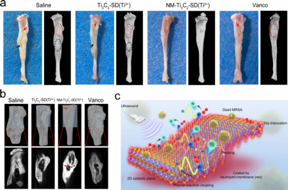 HKUMed invents a novel two-dimensional (2D) ultrasound-responsive antibacterial nano-sheets to effectively address bone tissue infection.
CREDIT
The University of Hong Kong
HKUMed invents a novel two-dimensional (2D) ultrasound-responsive antibacterial nano-sheets to effectively address bone tissue infection.
CREDIT
The University of Hong Kong
Abstract: A research team led by Professor Kelvin Yeung Wai-kwok from the Department of Orthopaedics and Traumatology, School of Clinical Medicine, LKS Faculty of Medicine, the University of Hong Kong (HKUMed) has invented a non-invasive and non-antibiotics technology to effectively reduce methicillin-resistant Staphylococcus aureus (MRSA) infection in bony tissue. The novel antibacterial nano-sheets can release a substantial amount of reactive oxygen species (ROS) subject to ultrasound stimulation. With the engulfment of neutrophil membrane (NM), the nano-sheets are able to actively capture the MRSA bacteria deeply seated in bony tissue and effectively eliminate 99.72% � 0.03%. The outcome has been published in Advanced Materials
Hong Kong, China | Posted on March 24th, 2023
BackgroundBone infection, namely osteomyelitis, is an infection happened in bone or bone marrow caused by bacteria, fungi, or other microorganisms. The common causative pathogenic organism is MRSA. Severe infections can put patients at the risk of amputation or even induce life-threatening sepsis. In clinical practice, the treatment of bone tissue infection typically involves antibiotics and surgical debridement to remove the infected bone or tissue. However, excessive use of antibiotics not only compromises the host�s innate immune function, but may also inevitably induce the emergence of drug-resistant pathogens. Recently, phototherapy, whatever it is photodynamic or photothermal therapy, has been applied as an antibiotic-free strategy to tackle bacterial infections. However, conventional phototherapy is unable to address the deep tissue infection such as bone due to its limited penetration power. Therefore, an alternative antibiotic-free strategy harnessing the penetration power of ultrasound to human tissues is considered.
Research method and findingsThe HKUMed research team has invented a new two-dimensional (2D) sonosensitiser, namely Ti3C2-SD(Ti3+) nano-sheets (nano sheets). Compare with the conventional sonosensitiser arranged in zero-dimension, in which the efficiency of ROS generation is limited. The innovative 2D sonosensitiser containing an abundance of planar catalytic sites can effectively generate a substantial amount of ROS when it is triggered by ultrasound signal. After decorated with neutrophil membrane (NM), the NM-Ti3C2-SD(Ti3+) nano-sheets (NM-nano-sheets) are able to actively track down the MRSA bacteria in bony tissue subject to ultrasound stimulation. In animal model, the novel nano-sheets have eliminated the MRSA bacteria in bone more than 99.72% in, whereas the antibiotics therapy (Vanco) is ineffective. Furthermore, the NM-nano-sheets can also alleviate tissue inflammation and assist bone repair once bony tissue infection has been controlled. In addition, the NM-coated nano-sheets do not present any acute bio-safety issues.
Research significanceProfessor Kelvin Yeung Wai-kwok, remarked, �Our design has achieved a qualitative leap in which the ROS catalytic site in sonosensitiser has transformed from zero-dimensional to two-dimensional. This invention can remarkably increase the production of bactericide (ROS). We may also consider applying this invention to the post-operation bacterial infection commonly seen in bone cancer patients or the patients with cystitis and peritonitis in the future.�
About the research teamThis research study was led by Professor Kelvin Yeung Wai-kwok, Department of Orthopaedics and Traumatology, School of Clinical Medicine, HKUMed. Dr Mao Congyang, postdoctoral fellow, is the first author. The research interests of Professor Yeung�s team include spinal deformities, orthopaedic biomaterials, musculoskeletal tissue engineering, 3D bio-printing and anti-bacterial nano-materials.
AcknowledgmentsThis work was jointly supported by National Key R&D Programmes of China (R&D#2018YFA0703100), General Research Fund of Hong Kong Research Grant Council (Nos. 17214516 and 17207719), Hong Kong Health and Medical Research Fund (Nos.19180712, 20190422 and 21200592), Innovation and Technology Fund Partnership Research Programme (#PRP/030/30FX), The National Science Fund for Distinguished Young Scholars (No. 51925104), Shenzhen Science and Technology Funding (Nos. JCYJ20210324120012034 and JCYJ20210324120009026), and Shenzhen�s Sanming Project of Medicine - �Team of Excellence in Spinal Deformities and Spinal Degeneration� Diseases (SZSM201612055).
Media enquiriesPlease contact LKS Faculty of Medicine of The University of Hong Kong by email
####
For more information, please click here
Contacts:Jaymee NgThe University of Hong Kong
Copyright © The University of Hong Kong
If you have a comment, please Contact us.
Issuers of news releases, not 7th Wave, Inc. or Nanotechnology Now, are solely responsible for the accuracy of the content.
Bookmark:


News and information
 New family of wheel-like metallic clusters exhibit unique properties April 14th, 2023
Efficient heat dissipation perovskite lasers using a high-thermal-conductivity diamond substrate April 14th, 2023
Nanobiotechnology: How Nanomaterials Can Solve Biological and Medical Problems April 14th, 2023
New Developments in Biosensor Technology: From Nanomaterials to Cancer Detection April 14th, 2023
2 Dimensional Materials
Graphene grows � and we can see it March 24th, 2023
New study opens the door to ultrafast 2D devices that use nonequilibrium exciton superdiffusion February 10th, 2023
Wafer-scale 2D MoTe₂ layers enable highly-sensitive broadband integrated infrared detector January 6th, 2023
Possible Futures
New family of wheel-like metallic clusters exhibit unique properties April 14th, 2023
Diamond cut precision: University of Illinois to develop diamond sensors for neutron experiment and quantum information science April 14th, 2023
Channeling mechanical energy in a preferred direction April 14th, 2023
Implantable device shrinks pancreatic tumors: Taming pancreatic cancer with intratumoral immunotherapy April 14th, 2023
Discoveries
Efficient heat dissipation perovskite lasers using a high-thermal-conductivity diamond substrate April 14th, 2023
Data can now be processed at the speed of light! April 14th, 2023
Diamond cut precision: University of Illinois to develop diamond sensors for neutron experiment and quantum information science April 14th, 2023
Channeling mechanical energy in a preferred direction April 14th, 2023
Announcements
Nanobiotechnology: How Nanomaterials Can Solve Biological and Medical Problems April 14th, 2023
New Developments in Biosensor Technology: From Nanomaterials to Cancer Detection April 14th, 2023
IOP Publishing celebrates World Quantum Day with the announcement of a special quantum collection and the winners of two prestigious quantum awards April 14th, 2023
Data can now be processed at the speed of light! April 14th, 2023
Interviews/Book Reviews/Essays/Reports/Podcasts/Journals/White papers/Posters
New family of wheel-like metallic clusters exhibit unique properties April 14th, 2023
Efficient heat dissipation perovskite lasers using a high-thermal-conductivity diamond substrate April 14th, 2023
Diamond cut precision: University of Illinois to develop diamond sensors for neutron experiment and quantum information science April 14th, 2023
Channeling mechanical energy in a preferred direction April 14th, 2023
Nanobiotechnology
Nanobiotechnology: How Nanomaterials Can Solve Biological and Medical Problems April 14th, 2023
Implantable device shrinks pancreatic tumors: Taming pancreatic cancer with intratumoral immunotherapy April 14th, 2023
