We use cookies to provide you with the best of services and customized features. By continuing to browse this website, you give your informed consent to our Cookie Policy.
When many quantum particles interact, complex systems can be formed. And this complexity allows reaching a temperature of absolute zero—at least in principle.
Framework: We consider the task of cooling a quantum system in two extremal control scenarios, with each step of both paradigms comprising two primitives. The top panel depicts the coherent-control scenario: in the control step (left), an agent can use a work source W to implement any global unitary on the system S and machine M, which both begin thermal at inverse temperature β; in cooling the target, energy and entropy is transferred to the machine. The machine then rethermalizes with its environment (right), thereby dissipating the energy it gained in the control step. The bottom panel depicts the incoherent-control scenario: the machine is bipartitioned into a cold part at inverse temperature β and a hot part at inverse temperature βH

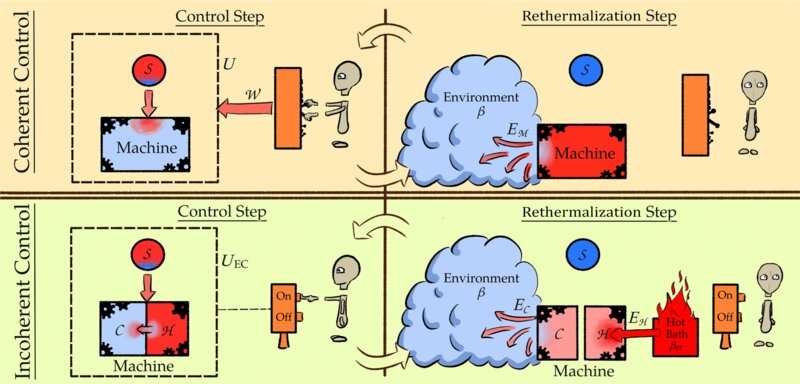 Framework: We consider the task of cooling a quantum system in two extremal control scenarios, with each step of both paradigms comprising two primitives. The top panel depicts the coherent-control scenario: in the control step (left), an agent can use a work source W to implement any global unitary on the system S and machine M, which both begin thermal at inverse temperature β; in cooling the target, energy and entropy is transferred to the machine. The machine then rethermalizes with its environment (right), thereby dissipating the energy it gained in the control step. The bottom panel depicts the incoherent-control scenario: the machine is bipartitioned into a cold part at inverse temperature β and a hot part at inverse temperature βH