
Further, because the researchers’ methodology could be applied to existing silicon photonics platforms with heterogeneously integrated pump lasers, the development could enable flexible, coherent light generation across a broad range of wavelengths and with high output power and efficiency.
The researchers began by studying nonlinear optical devices, including those made of silicon nitride, in which the color of the laser light entering a device can differ from the color that exits it. They experimented with converting incoming light into two different frequencies and demonstrated that the conversion process can occur within a silicon nitride microresonator. As the light traveled thousands of times around the ring-shaped microresonator, it grew strong enough to be converted into the two different frequencies. The two colors were then coupled into a waveguide that transported the light to where it was needed.
The dimensions of the microresonator and the color of the input laser light determine which colors are generated. The researchers fabricated several different microresonators, each with slightly different dimensions, to provide access to a range of output colors on a single chip, all from the same input laser.
Although this was an important first step, the process was found to be highly inefficient, converting less than 0.1% of the input laser light into one of the two output colors. Most of this inefficiency could be traced back to poor coupling between the microresonator ring and the waveguide.
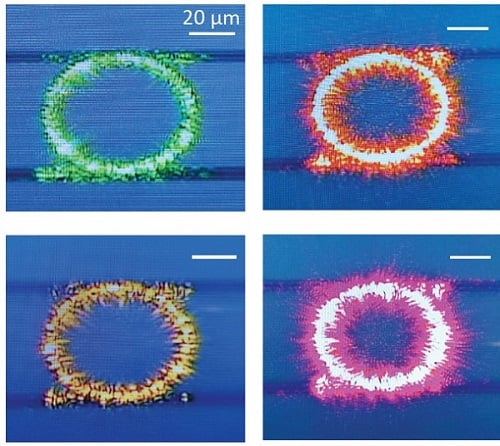
In addition, the converted light now demonstrated more than 1 mW of power over a range of wavelengths, from the visible to the near-infrared. The researchers estimated on-chip output powers for the signal and idler waves to be between 1 and 5 mW. This is enough power to generate quantum states of light, such as single-photon states, from single atoms or atom-like systems such as quantum dots. These milliwatt power levels can also provide sufficient power for laser stabilization.
Increasing the coupling between the ring and the waveguide and suppressing effects that could interfere with the color conversion further improved the power output and efficiency of the technique. These enhancements further increased the output laser power to as high as 20 mW and allowed as much as 29% of the incident laser light to be converted to the desired output colors. The researchers achieved high performance by suppressing competitive processes and by strongly overcoupling the output light.
By developing the methodology on a platform compatible with silicon photonics, the researchers have made it suitable for wide-scale deployment outside of laboratory settings.
The research was published in APL Photonics (www.doi.org/10.1063/5.0117691) and Nature Communications (www.doi.org/10.1038/s41467-022-35746-9).
