
Researchers at Pohang University of Science and Technology (POSTECH) and ITMO University addressed this bottleneck, producing a tip-enhanced photoluminescence (TEPL) spectroscopy system that controlled the quasiparticles of a 2D material in a small space. The spectroscopy system dynamically controls the physical properties of quasiparticles under room temperature conditions. Further, it can be used to analyze the optical characteristics of semiconductor quasiparticles in real time.
The research findings support the potential for applications of 2D semiconductors based on heterostructures and could give rise to new strategies for developing nano-excitonic and nano-trionic devices using TMD (transition metal dichalcogenide) heterobilayers. The technology is also expected to be used in developing high-luminance, ultrathin, wearable optoelectronic devices.
Using the TEPL spectroscopy technique at about a spatial resolution level of about 20 nm, the researchers demonstrated dynamic control of interlayer excitons and interlayer trions formed at the heterobilayers of TMDs. When a TMD is separated into a single layer, it is transformed into a thin, 2D film that exhibits the same characteristics as a high-performing semiconductor. Different combinations of TMD types and different methods of stacking TMD layers can produce a range of different properties.
Interlayer excitons of TMD heterobilayers are electrically neutral quasiparticles that exhibit photoluminescence, which is a property of semiconductors; interlayer excitons can be used in semiconductor devices with limited heat because they are composed of both light and matter. They can also be used as a light source for quantum information technologies because they have a longer coherence time than excitons.
However, interlayer excitons have low luminous efficiency at room temperature, and it is difficult to modulate their luminous energy.
To overcome these challenges, the tip-enhanced spectroscopy technique developed by the POSTECH-ITMO researchers can be adjusted by gigapascal (GPa)-scale pressure and near-field intensity.
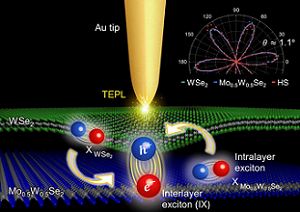
According to the researchers, their approach presents the first-ever scanning-tip hot electron regulator that can precisely control the hot electron transfer rate or trion-conversion rate in a fully reversible fashion.
The research was published in Light: Science & Applications (www.doi.org/10.1038/s41377-023-01087-5).
