
| Date | 20th, Apr 2023 |
|---|
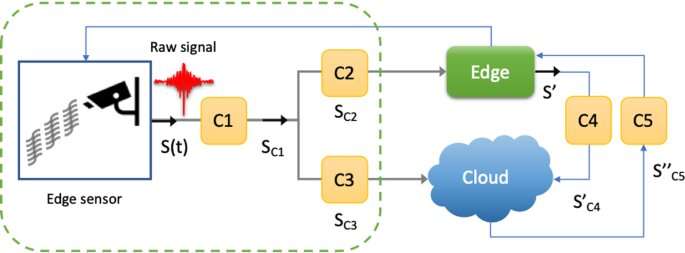 Graphical abstract. Credit: Computing (2023). DOI: 10.1007/s00607-023-01154-0
A study led by Oak Ridge National Laboratory researchers identifies a new potential application in quantum computing that could be part of the next computational revolution. The work is published in the journal Computing.
The study surveys techniques for compressing data generated by sensors in edge computing—which processes data at or near sensors—and compares classical techniques with quantum approaches, which are mostly in development. Compressing data saves storage space and network bandwidth.
Classical computing stores information in bits equal to 0 or 1. Quantum computing stores information in qubits, which can exist in more than one state simultaneously and can carry more information than classical bits.
"Classical data compression is pretty well defined, but not quantum compression," said Sarah Chehade, an ORNL postdoc and co-author of the study with ORNL's Ali Passian. "We wanted to identify where quantum compression stands as a new enabling tool for edge applications so we can start more conversations on a definition and standards."
UT-Battelle manages ORNL for the DOE's Office of Science, the single largest supporter of basic research in the physical sciences in the United States. The Office of Science is working to address some of the most pressing challenges of our time.
More information: Maryam Bagherian et al, Classical and quantum compression for edge computing: the ubiquitous data dimensionality reduction, Computing (2023). DOI: 10.1007/s00607-023-01154-0
Citation: Study seeks to define quantum compression (2023, April 20) retrieved 3 May 2023 from https://techxplore.com/news/2023-04-quantum-compression.html
This document is subject to copyright. Apart from any fair dealing for the purpose of private study or research, no part may be reproduced without the written permission. The content is provided for information purposes only.
