We use cookies to provide you with the best of services and customized features. By continuing to browse this website, you give your informed consent to our Cookie Policy.
MIT engineers have designed a new nanoparticle sensor that could enable early diagnosis of cancer with a simple urine test. The sensors, which can detect many different cancerous proteins, could also be used to distinguish the type of a tumor or how it is responding to treatment.
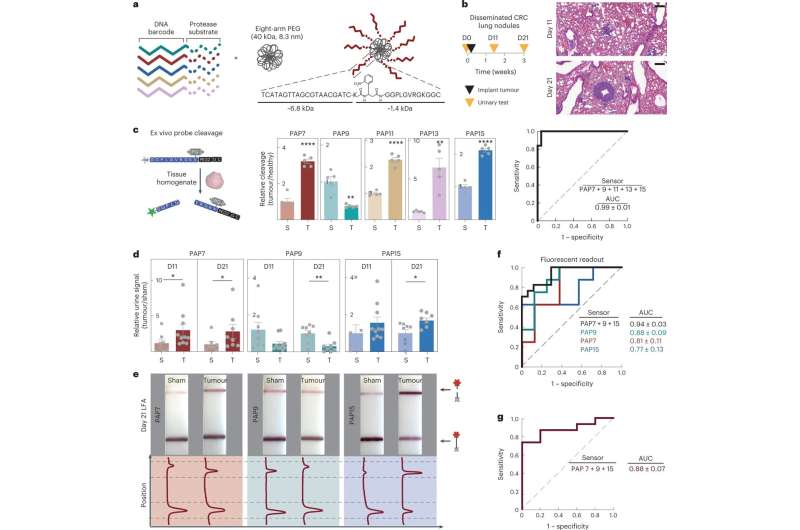
Multiplexed DNA-encoded synthetic urine biomarkers for portable monitoring of invasive colorectal cancer. a, Multiplexed DNA-SUBs are comprised of a polymeric nanocarrier (eight-arm PEG) functionalized with protease-activated peptides barcoded with oligonucleotides. b, Left: Timeline of longitudinal tumor monitoring with DNA-SUB. D, day. Right: histological lung staining of BALB/c mice bearing CRC lung tumors at 11 days (upper) and 21 days (lower) after tumor inoculation. Scale bar, 200 µm. c, Left: Schematic of the fluorogenic assay to identify peptide substrates specifically cleaved by lung tissue homogenates collected 21 days after tumor inoculation. Middle: Peptide cleavage by CRC-bearing and healthy lung tissue homogenates were monitored and cleavage rates normalized to healthy tissue are shown in bar graphs (n = 5 mice per group; mean ± s.e.m.; unpaired two-tailed t-test with Welch’s correction, ****P

 Multiplexed DNA-encoded synthetic urine biomarkers for portable monitoring of invasive colorectal cancer. a, Multiplexed DNA-SUBs are comprised of a polymeric nanocarrier (eight-arm PEG) functionalized with protease-activated peptides barcoded with oligonucleotides. b, Left: Timeline of longitudinal tumor monitoring with DNA-SUB. D, day. Right: histological lung staining of BALB/c mice bearing CRC lung tumors at 11 days (upper) and 21 days (lower) after tumor inoculation. Scale bar, 200 µm. c, Left: Schematic of the fluorogenic assay to identify peptide substrates specifically cleaved by lung tissue homogenates collected 21 days after tumor inoculation. Middle: Peptide cleavage by CRC-bearing and healthy lung tissue homogenates were monitored and cleavage rates normalized to healthy tissue are shown in bar graphs (n = 5 mice per group; mean ± s.e.m.; unpaired two-tailed t-test with Welch’s correction, ****P