
There is significant interest in achieving very high frequency detection of extreme-ultraviolet (EUV) light in order to observe objects at the nanoscale. “With violet light we can see much smaller things compared to using red light,” researcher Sergey Kruk of ANU said. “And with extreme-ultraviolet light sources, we can see things beyond what’s possible using conventional microscopes of today.”
High-harmonic generation (HHG) is one of the pathways leading toward light sources in the EUV and vacuum-UV spectral ranges. HHG is a nonlinear process, during which a target sample is illuminated by an intense laser pulse. The sample, in response, will emit the high harmonics of the generation beam (that is, above the fifth harmonic).
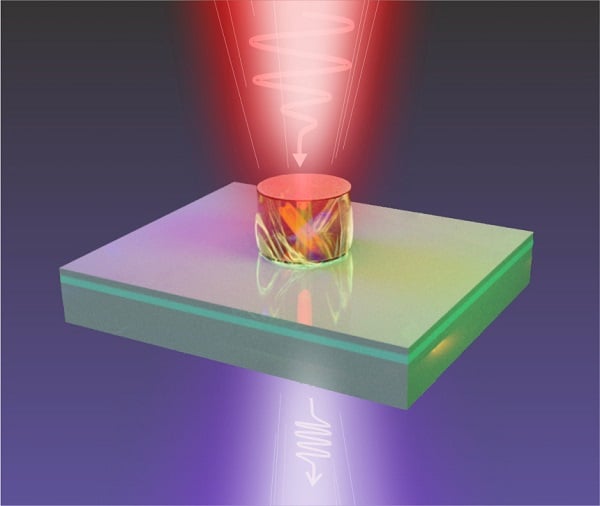

The researchers excited the resonant modes with an azimuthally polarized, tightly focused beam, and evaluated the contributions of perturbative and nonperturbative nonlinearities to the harmonic generation process.
The results of the research open a path to miniaturizing light sources toward the subwavelength scale in solid-state systems. Such light sources could be used to help create a new generation of microscopes that can produce images in greater detail.
“Scientists who want to generate a highly magnified image of an extremely small, nanoscale object can’t use a conventional optical microscope,” researcher Anastasiia Zalogina of ANU said. “Instead, they must rely on either superresolution microscopy techniques or use an electron microscope to study these tiny objects. But such techniques are slow, and the technology is very expensive, often costing more than $1 million.” Electron microscopy can also damage delicate samples, Zalogina said.

 Researcher Anastasiia Zalogina is a member of the team at ANU in Canberra, Australia, that is developing nanoparticles to increase the frequency of light. Courtesy of Martin Conway/ANU.
High-frequency light sources make it possible to view objects that are too small to be visualized with conventional microscopes. The ability to visualize nanosize objects, such as individual viruses, could increase scientific understanding of some diseases and how to treat them.
Researcher Anastasiia Zalogina is a member of the team at ANU in Canberra, Australia, that is developing nanoparticles to increase the frequency of light. Courtesy of Martin Conway/ANU.
High-frequency light sources make it possible to view objects that are too small to be visualized with conventional microscopes. The ability to visualize nanosize objects, such as individual viruses, could increase scientific understanding of some diseases and how to treat them.
“Conventional microscopes are only able to study objects bigger than about ten-millionth of a meter. However, there is growing demand across a range of sectors, including the medical field, to be able to analyze much smaller objects down to one-billionth of a meter,” Zalogina said. “Our technology could help meet that demand.”
The researchers’ work in the area of higher-order optical harmonics could also improve quality control in the semiconductor industry, where a 1% increase in yields is estimated to generate about $2 billion in savings.
“Computer chips consist of very tiny components with feature sizes almost as small as one-billionth of a meter,” Kruk said. “During the chip production process, it would be beneficial for manufacturers to use tiny sources of extreme-ultraviolet light to monitor this process in real time to diagnose any problems early on. That way, manufacturers could save resources and time on bad batches of chips, thereby increasing yields of chip manufacturing.”
The research was published in Science Advances (www.doi.org/10.1126/sciadv.adg2655).
