
| Date | 6th, May 2023 |
|---|
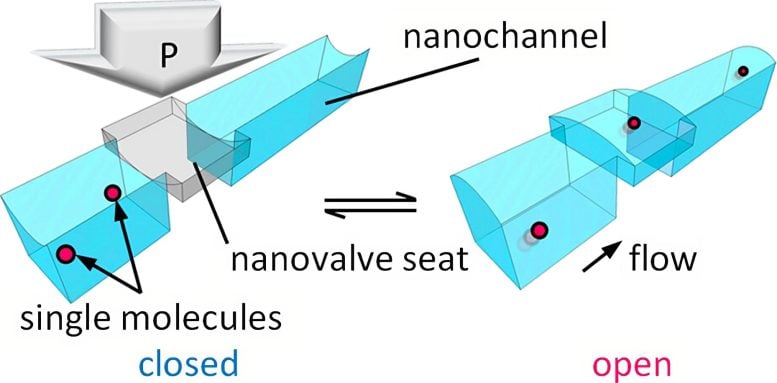
Schematic drawing of the working principle of the single-molecule valve. Credit: Yan Xu, Osaka Metropolitan University
The scientific community envisions utilizing minute molecules as foundational elements to construct objects, similar to how we assemble things with mechanical components. However, the challenge lies in the fact that molecules are incredibly small, approximately one hundred millionth the size of a softball, and they move randomly in liquids, making it difficult to control and manipulate them into a single form.
To overcome this obstacle, “nanofluidic devices” that can convey molecules through remarkably narrow channels, similar in dimension to one-millionth of a straw, have garnered interest as a means of directly controlling individual molecules in solutions.
A joint research team led by Associate Professor Yan Xu of the Osaka Metropolitan University Graduate School of Engineering has succeeded in regulating the flow of single molecules in solution by opening and closing a nanovalve in a nanofluidic device by applying external pressure.
