
| Date | 12th, May 2023 |
|---|
Home > Press > Nanonitrator: novel enhancer of inorganic nitrate protective effects, predicated on swarm learning approach
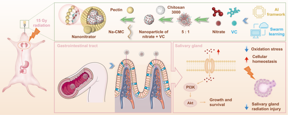 A swarm learning-based drug combination prediction system identifying vitamin C as the optimal drug to be combined with sodium nitrate. This combination improved the bioavailability of sodium nitrate and exerted synergistic effects. Subsequently, the team used microencapsulation technology to prepare a nanoparticle named Nanonitrator, with sodium nitrate and vitamin C as its primary components. Nanonitrator prevented tissue damage in a model of radiation-induced salivary gland injury, verifying their improved efficacy over that of sodium nitrate alone.
CREDIT
�Science China Press
A swarm learning-based drug combination prediction system identifying vitamin C as the optimal drug to be combined with sodium nitrate. This combination improved the bioavailability of sodium nitrate and exerted synergistic effects. Subsequently, the team used microencapsulation technology to prepare a nanoparticle named Nanonitrator, with sodium nitrate and vitamin C as its primary components. Nanonitrator prevented tissue damage in a model of radiation-induced salivary gland injury, verifying their improved efficacy over that of sodium nitrate alone.
CREDIT
�Science China Press
Abstract: Radiotherapy is currently the main form of treatment for head and neck malignancies such as nasopharyngeal carcinoma. Within the radiation field of a tumor, salivary glands frequently suffer substantial damages following irradiation, resulting in xerostomia and a series of oral syndromes, which seriously impact the quality of patients' lives.
Beijing, China | Posted on May 12th, 2023
In 1998, the research team led by Prof. Songlin Wang established a model of miniature pigs to simulate clinical salivary gland injuries induced by radiation in the head and neck region. The model was employed in a series of studies on the mechanism of radiation-induced salivary gland injuries as well as functional reconstruction of the damaged glands. The team found that exogenous inorganic nitrate supplementation could significantly protect the morphology and function of the salivary glands from radiation injury, suggesting a novel mode of prevention and treatment.
Most existing experimental studies on inorganic nitrate therapy are based on oral administration, including the addition of nitrates to food and drinking water. Orally administered nitrates have low bioavailability, rapid metabolism, and high fluctuation in vivo, making it difficult to achieve pharmacodynamically active concentrations. To resolve these issues and facilitate clinical applications, the team has successfully developed a drug combination prediction system based on swarm learning. Using a deep learning model, the system was trained on drug-pathway interaction data to construct a drug-pathway network. A graph convolutional neural network was used to construct a drug-target network to uncover optimal drug combinations. The system was used to successfully identify vitamin C as the optimal drug for co-administration with sodium nitrate. This finding provides new ideas and methods for drug co-administration, with important clinical implications for the prevention of various diseases.
From this, the optimal nitrate-to-vitamin C ratio was determined using microencapsulation technology for screening and optimization of the controlled release formulation. Thereby a hydrophobic nanodrug named Nanonitrator was prepared, using a core material solution containing sodium nitrate, vitamin C, and chitosan 3000, whereas sodium carboxymethyl cellulose (Na-CMC) and pectin were used as wall materials. The core and wall materials were mixed, lyophilized, and crushed into a powder form. The various pH values of gastrointestinal solutions tested in vitro confirmed that Nanonitrator is suitable in oral dosage forms.
Due to their ability to significantly enhance the signal transduction of the PI3K-Akt pathway, Nanonitrator exhibited better effects in maintaining intracellular homeostasis than sodium nitrate alone or sodium nitrate combined in a physical mixture with vitamin C at equivalent oral doses. Nanonitrator reduced radiation-induced oxidative stress in salivary gland cells, reduced ROS content, maintained cellular calcium homeostasis, protected mitochondrial morphology and function, and decreased the number of apoptotic cells.
These results suggest that Nanonitrator could be developed as a novel therapy of multiple applications, with the potential to play an important role in the prevention and treatment of related chronic diseases. Moreover, this study provides new ideas for the development of novel drugs based on inorganic salts.
####
For more information, please click here
Contacts:Media Contact
Bei YanScience China Press
Expert Contacts
Prof. Xiaogang WangSchool of Engineering Medicine, Beihang University
Prof. Yuji WangSchool of Pharmaceutical Sciences, Capital Medical University
Prof. Songlin WangCapital Medical University
Copyright © Science China Press
If you have a comment, please Contact us.
Issuers of news releases, not 7th Wave, Inc. or Nanotechnology Now, are solely responsible for the accuracy of the content.
Bookmark:


News and information
 Single quantum bit achieves complex systems modeling June 9th, 2023
Quantum materials: Electron spin measured for the first time June 9th, 2023
Liquid metal sticks to surfaces without a binding agent June 9th, 2023
Graphene-based Carbocatalysts: Synthesis, Properties, and Applications�Beyond Boundaries June 9th, 2023
Cancer
New Developments in Biosensor Technology: From Nanomaterials to Cancer Detection April 14th, 2023
Implantable device shrinks pancreatic tumors: Taming pancreatic cancer with intratumoral immunotherapy April 14th, 2023
Getting drugs across the blood-brain barrier using nanoparticles March 3rd, 2023
Possible Futures
USTC enhances fluorescence brightness of single silicon carbide spin color centers June 9th, 2023
Single quantum bit achieves complex systems modeling June 9th, 2023
Advances in nanotechnology application in biosafety materials A crucial response to COVID-19 pandemic June 9th, 2023
Researchers discover materials exhibiting huge magnetoresistance June 9th, 2023
Nanomedicine
Advances in nanotechnology application in biosafety materials A crucial response to COVID-19 pandemic June 9th, 2023
Nanobiotechnology: How Nanomaterials Can Solve Biological and Medical Problems April 14th, 2023
Implantable device shrinks pancreatic tumors: Taming pancreatic cancer with intratumoral immunotherapy April 14th, 2023
Discoveries
When all details matter -- Heat transport in energy materials June 9th, 2023
Advances in nanotechnology application in biosafety materials A crucial response to COVID-19 pandemic June 9th, 2023
Researchers discover materials exhibiting huge magnetoresistance June 9th, 2023
Announcements
Liquid metal sticks to surfaces without a binding agent June 9th, 2023
Graphene-based Carbocatalysts: Synthesis, Properties, and Applications�Beyond Boundaries June 9th, 2023
When all details matter -- Heat transport in energy materials June 9th, 2023
Interviews/Book Reviews/Essays/Reports/Podcasts/Journals/White papers/Posters
USTC enhances fluorescence brightness of single silicon carbide spin color centers June 9th, 2023
Single quantum bit achieves complex systems modeling June 9th, 2023
Advances in nanotechnology application in biosafety materials A crucial response to COVID-19 pandemic June 9th, 2023
Researchers discover materials exhibiting huge magnetoresistance June 9th, 2023
Nanobiotechnology
Nanobiotechnology: How Nanomaterials Can Solve Biological and Medical Problems April 14th, 2023
Implantable device shrinks pancreatic tumors: Taming pancreatic cancer with intratumoral immunotherapy April 14th, 2023
HKUMed invents a novel two-dimensional (2D) ultrasound-responsive antibacterial nano-sheets to effectively address bone tissue infection March 24th, 2023
Lipid nanoparticles highly effective in gene therapy March 3rd, 2023
